
By Germán Reyes
Omoa (Honduras), May 17 (EFE).- Honduran Héctor Pérez has tried to migrate to the United States eight times, and all eight times he was deported. As a result, he has given up. Other deportees, however, take the route north the same day they set foot back in Honduras with the need to escape misery and in search of the “American dream.”
“I think this is the last time I’ll try,” Pérez told EFE after having attempted to reach the US on eight occasions between 2022 and 2024, the last time at the beginning of April. It’s a “very tough” situation, but unfortunately “the opportunity has not arisen,” perhaps because “it is God’s will that we do not achieve our goal.”
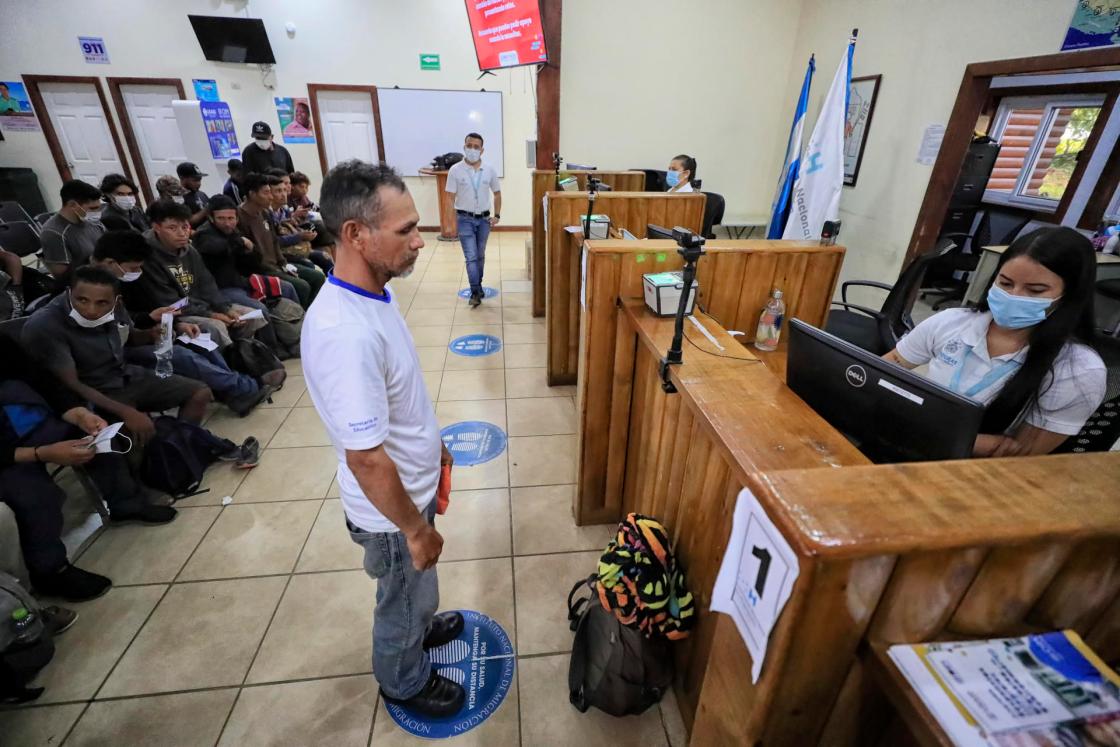
Perez, 44, is at the Care Centre for Returned Migrants in Omoa, in the Honduran Caribbean, which is run by the Red Cross in collaboration with the International Federation of Red Cross and Red Crescent Societies (IFRC) and other organizations such as the European Union.
The welder and father of three explains that he left because “the salaries are inadequate” in Honduras.
So, on 16 September 2022, he tried for the first time but was detained in Villahermosa, Mexico. Two other times he was detained when he tried to cross the Rio Bravo to reach Texas, and the rest in the Mexican town of Piedras Negras, on the border with the United States.
“On this journey, you suffer many things, attacks, cold, hunger, everything. You have to walk day and night if possible, everything happens on the road, assaults, robberies by criminal gangs that are just around the corner,” says Pérez, who recently returned on a bus from Mexico.
Other deportees accompanying him don’t think twice, and that same day they take the same route north. Some say that the violence in their communities caused by the ‘maras’ gangs leaves them no other option.
Hurricanes, violence and poverty
Honduras’ migration crisis worsened after the devastating Hurricane Mitch in late 1998, which pushed some 100,000 Hondurans towards the United States, a high percentage of whom were granted Temporary Protected Status that can be renewed every 18 months.
After Hurricane Mitch, high unemployment, low wages, and gang violence magnified migration to North America and Europe, which was compounded in 2018 by the migrant caravan phenomenon.
It is estimated that around 1.5 million Hondurans live abroad, mostly in the US, and each year they send around 10 billion dollars in remittances, more than 20 percent of the gross domestic product (GDP) of Honduras, where 60 percent of its 10 million inhabitants live in poverty.
Although there are no official figures, the International Migration Observatory at the National Autonomous University of Honduras estimates that in the first quarter of 2024 alone, more than 60,000 Hondurans migrated.
Deportations are also numerous: by air from the US, by land from Mexico and Guatemala, or by sea from Belize, the director general of the Honduran Red Cross, Alexei Castro, explained to EFE.
In 2023, the Care Centre for Returned Migrants in Omoa received between two and three buses a day with some 160 migrants, although by the end of the year, the number had decreased.
Families receive help at the Belén Centre, in the northern town of San Pedro Sula from the Red Cross in coordination with other entities such as the Children, Adolescents and Family Secretariat. With a capacity to attend to some 100 migrants, in “high season” they receive up to 160 returnees daily.


Women and children, the most affected
“Families with children have to come to the Belén Centre,” which can receive 42 women, 42 men, and five families of five people each, Gabriela Oviedo, the Red Cross administrator at the center, explained to EFE.
Most returnees arrive by air from the US, sometimes on two or three flights a week. Due to the lack of space and the fact that families and unaccompanied minors are received almost every week, returnees have a maximum of 72 hours to stay at the center, although in some cases their stay can be extended to up to a week.
This is the case of a 14-year-old boy, the son of farm workers from a community in Copán, in western Honduras, who left in March for the United States to help his family and was detained and deported in the Mexican town of Tapachula, 15 days after starting his journey.
The Children, Adolescents and the Family Secretariat reported in April that at least 2,216 Honduran children had been deported since January.
Many of these children are traveling with their mothers, like little Belén and her mother Sandra Alberto, 29.
“I’m a single mother, I decided to leave because of the situation I’m in, I can’t find work and every day it gets more complicated with the two girls”, Alberto told EFE at the Belén Centre.
On 15 March she left with her youngest daughter for the United States after being fired from a factory, for being 30 years old, but with a little girl the journey was “quite complicated.”
“The trip was very difficult because I had to travel alone, I traveled by bus, in a trailer, I had to sleep in the bush, in abandoned houses,” she explained.
“All along the way I kept asking God to help me, to always put good people in my path, and that’s how it was, I made it all the way to Mexicali” in Baja California, but it all ended when immigration officers intercepted and deported them. And they had to start all over again. EFE
(This article was written in collaboration with the International Federation of Red Cross and Red Crescent Societies (IFRC), which has programs to help migrants with support from donors such as the European Union.)