
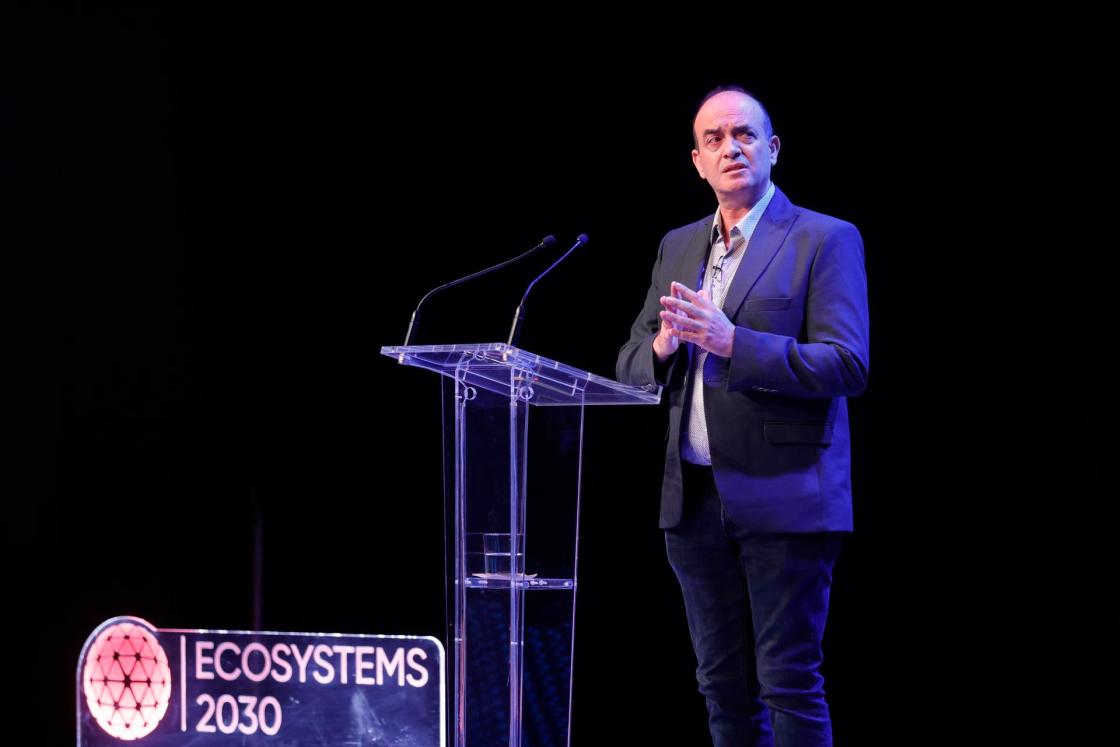
A Coruña (Spain), Oct 3 (EFE).- Ecosystems 2030 Executive Chairman Omar Hatamleh has expressed his commitment to “changing mindsets” to tackle the challenges posed by artificial intelligence (AI), which has and will continue to impact all areas of life: from work to medicine and finance.
Hatamleh raised the issue on Friday at the opening of the fifth edition of the Ecosystems 2030 international forum, held at the Exhibition and Congress Center (Palexco) in A Coruña (Spain), where some 50 experts gathered to share their views on the changes and challenges the world will face in the coming years and how to address them from an organizational perspective.
The executive explained, by way of introduction, that “for the first time, we are competing against intellect and not manual labor.”
“In addition to the obvious benefits, we are beginning to see a decline in critical thinking among human beings, which is very dangerous, so we have to leverage these technologies without affecting humans,“ he warned.
He added that we are still in the first phase of AI, which means that in the coming years, ”it will be able to reason more and will be very good at many functions in all industries.”
There will be a third phase in which “humanoid robots will be able to perform manual labor.”


Changing our mindset
Hatamleh explained that this will affect many areas, from longevity studies to pension systems and education systems.
“In order to adapt, we have to change our mindset,” he summarized, while calling for us to be ‘proactive’ because “the opportunities are immense.”
The Galician Minister of Education, Román Rodríguez, stated that Ecosystems 2030 helps “Galicia put itself on the technology map” at a time of “profound change.”
He pointed out that “there is a part of society that is afraid, but another group is obsessed with technological development,” so “progress lies in balance and control.”
A Coruña Mayor Inés Rey said that artificial intelligence “is a reality that challenges us as individuals, institutions, and society, an unprecedented transformation.”
She said that AI “is not here to replace us but to help us,” so it is necessary to “educate and regulate it.” EFE