
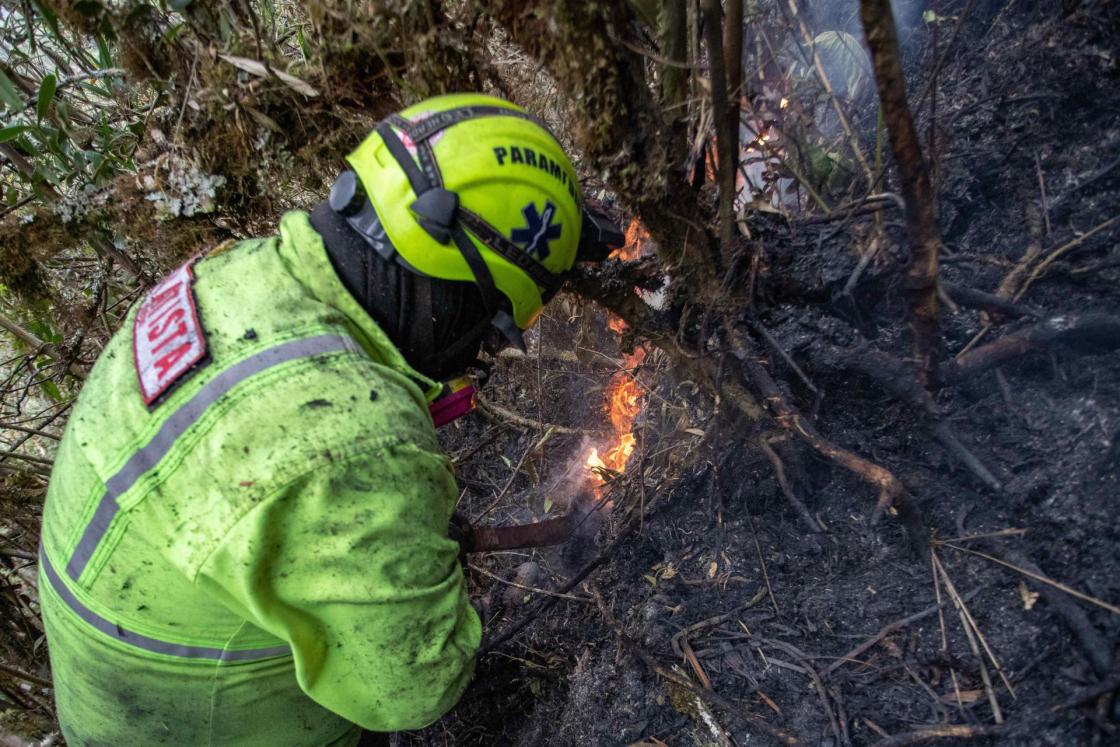
Lima, Sep 24 (EFE).- Forest fires have devastated thousands of hectares from the Amazon to the Andes in Peru and 20 people have died since July 1. Several experts consulted by EFE provide the keys to understanding how the country has reached this extreme:
1.- Climate change
A specialist from the United for Forests initiative of the Conservation and Sustainable Development Foundation (FCDS Peru), Fernando Regal, considers that climate change has created extreme conditions.
“We are in a context of climate change where we have a shorter rainy season and a longer dry season. This means that the soil, vegetation, and air will be drier and warmer,” he said.
He added that the rivers in the Peruvian jungle have less water flow and that the Amazon is about to reach its lowest-ever level.
2. Social factors
Agricultural burning is a traditional practice in the Andean grasslands and part of the rainforest. It is also the simplest and cheapest way for farmers to clear land and allow them to use the ash as fertilizer.
The executive director of the Common Good Institute (IBC), Renzo Piana, indicated that with the current weather conditions, these burns can get out of control very easily.
“Faced with these traditional practices, there is a very high risk that the fire will get out of control, and with a drier vegetation and environment and a larger accumulation of combustible material, these will be more serious,” he said.


3. Political factors
The experts agreed that politics is a contributing factor, especially after the Peruvian Congress modified the forestry law at the beginning of the year.
“In Peru, there have been changes in the environmental regulations that in a certain way favor the clearing of land, since they have made much more flexible the mechanisms that the State and the entities in charge of forest management have,” said Piana.
Regal added that this change in the legislation has created “a perverse incentive,” because now it is easier to convert forest land to agricultural use and obtain a property title, which encourages land trafficking.
4. Deforestation
Illegal logging and illicit activities such as mining or coca production worsen the situation.
“When we harm and degrade ecosystems, we take away their resilience to changes and extreme events such as fires,” said Regal.
In this sense, he said deforestation and fire points go hand in hand. For example, the two places in Peru with the greatest loss of forest in 2023 coincide with the two most important hot spots, which favors the ignition and propagation of fires.
5. Prevention
For this scenario not to be repeated next year, both emphasize the importance of working with communities to raise awareness of the risks of these burns, and provide them with tools and alternatives.
“There has to be work that brings awareness to the population that carries out these activities to be more careful and be accompanied by the State,” Regal said.
There is also a need for unified national planning and the creation of a structure for fire management and response, “because otherwise this will continue to happen,” he concluded. EFE
This report on forestry and land use issues is supported in part by the Climate and Land Use Alliance. EFE maintains complete editorial independence and is solely responsible for the content.