
Artificial intelligence is taking over monitoring, forecasting, and calculation tasks in China’s steel industry, which for decades has depended on worker experience, though humans still make key decisions.
That is the case at NISCO, which is developing these technologies alongside tech giant Huawei. Inside one of the sprawling plants at the Nanjing Iron & Steel (NISCO) complex in Nanjing in eastern China, a glowing red slab of steel glides across a series of rollers.
Even from an upper walkway, the passing metal emits a wave of heat that hits you as water jets cool the steel, sending up thick plumes of steam.
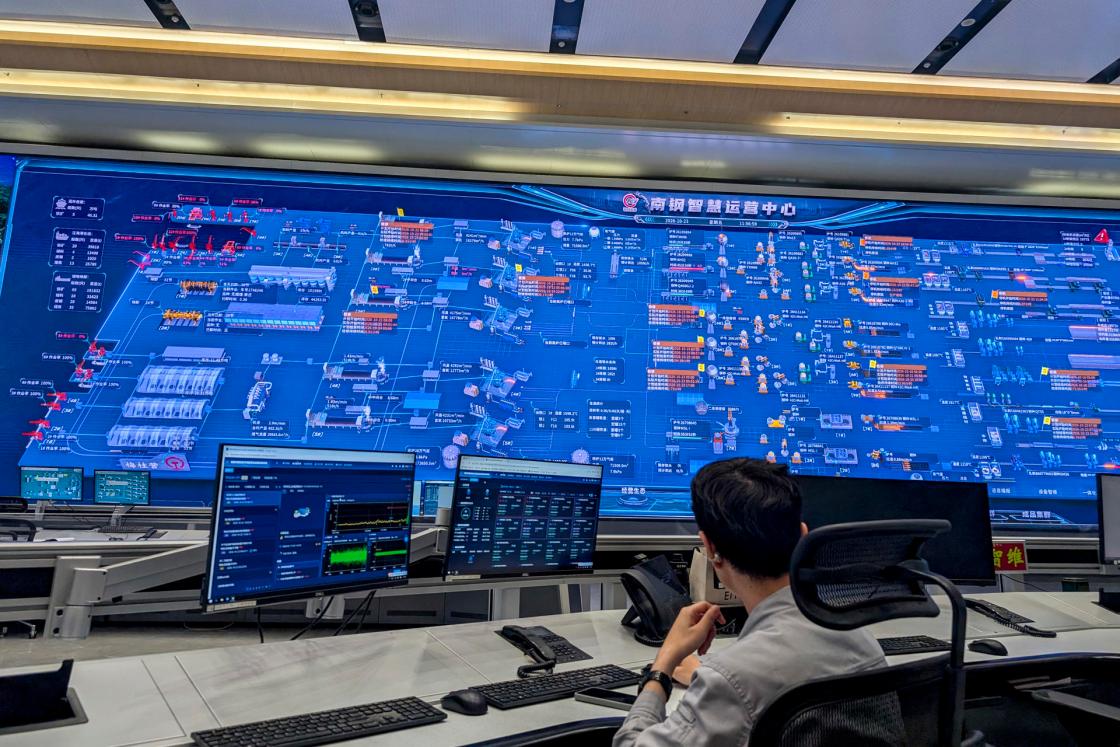
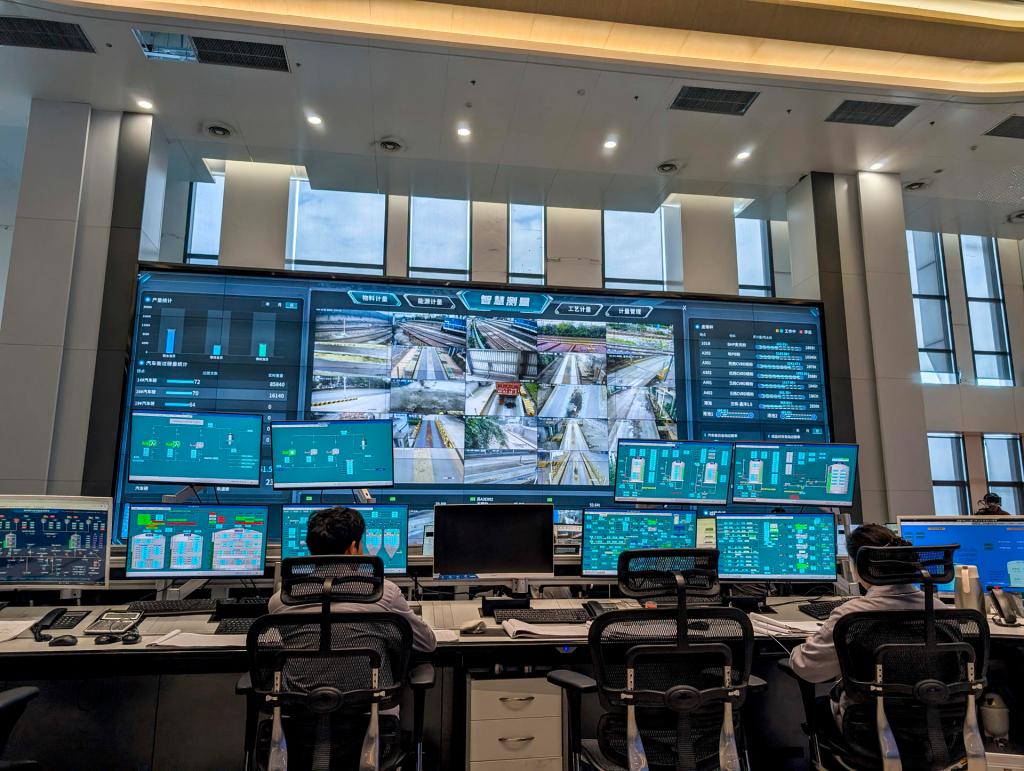
In a control center elsewhere in the massive facility, the scene is different: operators in blue uniforms sit before dozens of screens, camera feeds, and automated alerts in command rooms that the company says allow fully integrated monitoring of production.

From worker intuition to AI models
At the blast furnace, NISCO has installed thousands of sensors and monitoring devices to track variables such as temperature, pressure, and material composition.
“We can predict it two hours in advance” with an accuracy rate exceeding 90%, explained Liu Yonghui, director of the Digital Intelligence Center at NISCO’s Ironmaking Division, referring to a model that forecasts molten iron temperature trends and silicon content.
Liu, who worked at blast furnaces for years before moving to digital operations, recalled that much of the process once relied on workers’ accumulated experience.
Now, systems evaluate the furnace’s “health status,” identify anomalies, and trigger early warnings so operators can intervene before issues escalate.
A similar approach applies to the rolling mill, where models using historical datasets and expert knowledge recommend force levels, pass counts, and rolling speeds.
In quality control, NISCO says an AI-assisted automated metallographic analysis system achieves over 95% accuracy and has cut the time required to examine a sample from roughly 10 minutes to between three and five.
Workplace safety is another key driver behind the rapid overhaul.
According to China’s Ministry of Emergency Management, the country’s metallurgical sector recorded 78 workplace accidents and 95 deaths in 2024, excluding fires or incidents involving special equipment and gas.
While those figures reflect a 6% drop in total accidents compared to 2023, fatalities ticked up by 1.1%.
Official findings identified mechanical injuries, blunt trauma, toxic poisoning, and burns as primary hazards, recommending expanded automation and unmanned intelligent operations.

Multiple models
NISCO says it has invested more than 5 billion yuan ($749 million) in digital transformation.
A significant share of these tools is built around “YuanYe,” an industrial AI architecture tailored for the steel sector that combines specialized models with physics- and process-based frameworks, rather than relying on a single monolithic system across the entire facility.
Huawei has partnered with NISCO since 2019, initially focusing on digitalization before expanding into AI applications in 2024.
The tech giant provides computing infrastructure, platforms, tools, and data architecture, while NISCO and external partners build numerous plant-specific applications.
Cheng Yongfu, a steel solutions expert at Huawei — which collaborated with EFE on the distribution of this content — differentiates between automation, which carries out previously manual tasks, and AI, which is deployed primarily for decision-making, planning, and optimization.
In his view, expecting a single AI model to solve every operational challenge in a steel mill is “unrealistic,” given the diversity of processes and the “high level of reliability” industrial environments demand.
Humans at key stages
Despite rapid automation, NISCO maintains that human operators make the core decisions.
“At key stages, we still need people to make the decisions,” said Li Jinyan, director of NISCO’s AI Research Institute.
“This is not about replacing” workers, Li added, but rather using AI to boost efficiency and relieve staff from “hazardous and repetitive” tasks.
Asked by EFE what such plants might look like in 10 or 20 years, Cheng avoided making strict predictions, pointing instead to three ongoing shifts: removing workers from hazardous environments, integrating decades of institutional shop-floor knowledge with digital tools, and improving final product quality.
AI, he told EFE, can empower workers by pairing their accumulated expertise with models capable of analyzing more variables and recommending solutions. EFE