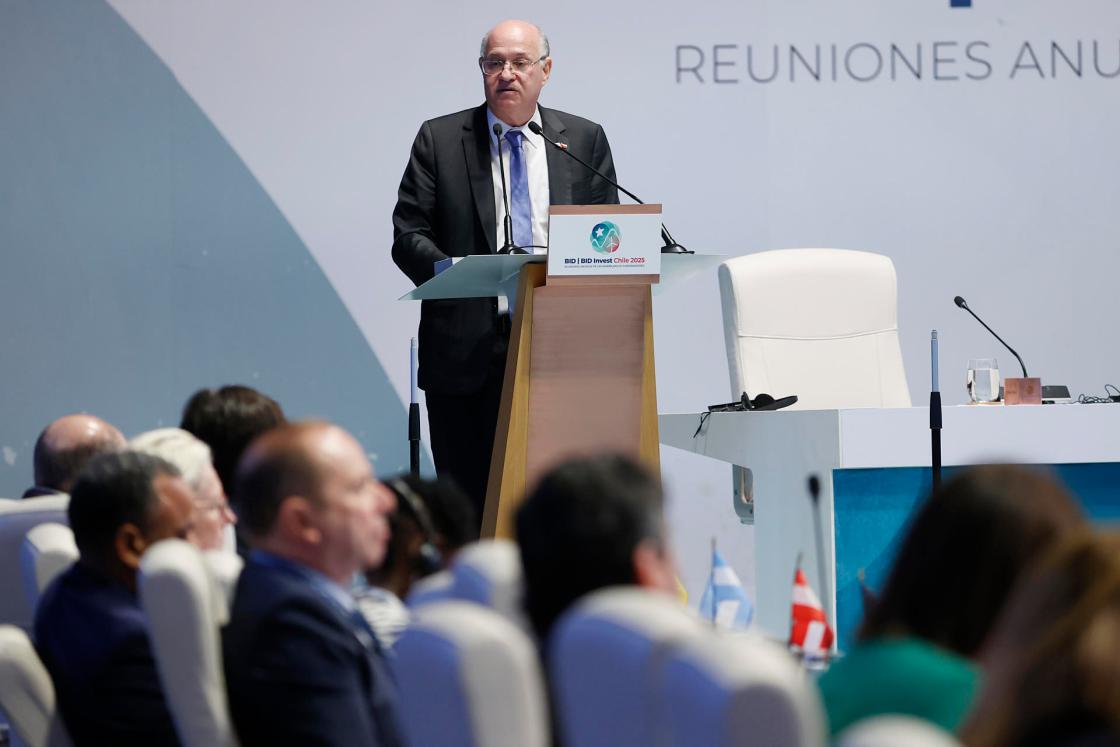
Washington, Mar 10 (EFE).- The Inter-American Development Bank (IDB) Group begins its annual meetings on Wednesday in Asunción, with the goal of further consolidating the efforts of its three main entities and analyzing the major challenges facing Latin America and the Caribbean, such as creating value chains for the critical minerals industry and stimulating regional competition.
The annual meetings, which are to run through to March 14 in the Paraguayan capital, take place, as IDB President Ilan Goldfajn told EFE, “against the backdrop of a record year; our financing for Latin America and the Caribbean reached $35 billion in 2025, of which $13 billion went to the private sector.”
Goldfajn highlighted the “strong interest” the event has generated among the private sector. Of the more than 4,000 participants from 48 countries expected to attend, 1,580 come from the business community, including more than 300 CEOs and more than 750 senior executives.
The head of the institution also stressed that the programs approved over the past year had an even greater impact, as they enabled some 34 million people to receive health and nutrition services, 2.6 million to gain access to broadband services, and 3.3 million “micro, small, and medium-sized enterprises” to receive support.
Looking ahead to the plenary sessions of the Boards of Governors to be held on March 13 and 14, Goldfajn noted that progress continues “in the implementation of BIDImpact+,” the framework approved at the 2024 annual meetings to further integrate the work of the three entities that make up the Group: IDB, focused on the public sector; IDB Invest, which works with the private sector; and IDB Lab, its innovation and entrepreneurship arm.
The plan involves designing and implementing a new institutional strategy to increase impact and scale in terms of development, completing the $3.5 billion capital increase for IDB Invest, aimed at “mobilizing private investment at scale,” and replenishing IDB Lab resources.
Positive outlook for critical minerals
Over the four days of the annual meetings, several seminars are scheduled to analyze major regional challenges, starting with the potential of the critical minerals industry.
Latin America is a key player in minerals considered essential for the technology and energy industries, from copper and nickel to rare earth elements, in some cases controlling more than a third of the world’s supply.
Demand is also expected to surge in the coming years for elements such as lithium, whose largest global reserves are found in Bolivia, Chile, and Argentina.
This presents a major opportunity, but also raises the need to not only focus on extraction and attracting new investment, but also to develop value chains that convert the industry into a driver of more sustainable and inclusive growth.
Another discussion session is to focus on one of the major tasks the IDB has identified as essential for Latin America and the Caribbean to boost productivity, increase wages, and control inflation: the need to strengthen competition to reduce the high levels of market concentration in the region.
The requirements for greater regional integration, the growth opportunities presented by the region’s rapidly aging population, and the prospects for increased investment following the signing of the trade agreement between Mercosur and the European Union (EU) are also to be addressed in the sessions in Asunción.
Goldfajn also noted that Paraguay “is a very timely host,” having “undergone a remarkable transformation, with the IDB Group as a partner in that journey,” and that it “has gained momentum thanks to the private sector.”
“It is an important example because we believe the private sector is fundamental to closing development gaps, while the public sector provides the enabling conditions. Development needs the private sector to bring scale, innovation, and jobs, and that is achieved with strong institutions and credible policies,” he concluded. EFE