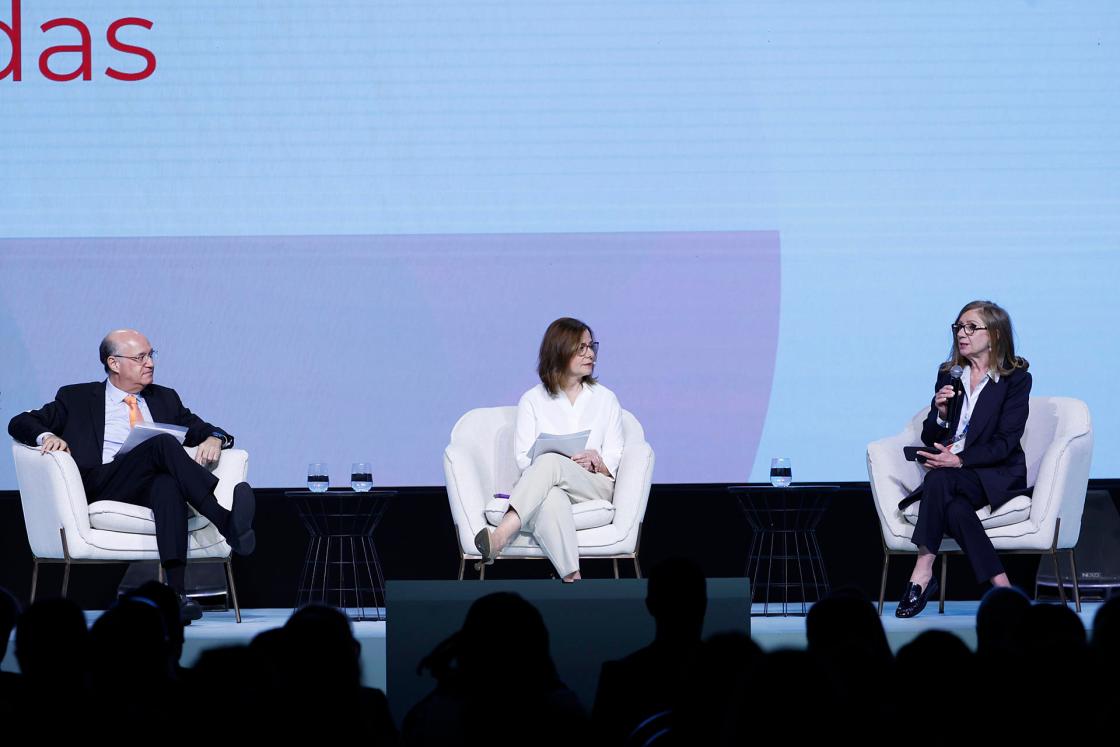
Santiago, Mar. 26 (EFE) – The Inter-American Development Bank (IDB) reaffirmed on Wednesday its commitment to act as a “bridge” for investors entering Latin America, emphasizing the need for strategic collaboration with civil society organizations to improve development outcomes across the region.
“We are going around the world telling investors to enter Latin America, that we are the bridge to Latin America because we give the guarantee that it is a good project,” said IDB President Ilan Goldfajn.
The Brazilian economist spoke during the opening panel of the seminars that precede the Annual Meeting of the IDB’s Board of Governors, composed of finance and economy ministers and senior officials from the 48 member countries. The board will meet March 28–30 in Santiago, Chile, to address development challenges and private-sector opportunities.

Expanding Scale and Impact in Latin America
“We want to be a bank that has a greater presence both in scale and impact,” said Goldfajn, who has led the IDB since December 2022.
Through the BID for the Americas program, launched in 2023, the IDB is increasing collaboration with the private sector, fostering business opportunities between 26 countries in Latin America and the Caribbean and key partners in Europe, North America, and Asia.
Civil Society: A Vital Partner in Development
Goldfajn emphasized the essential role of civil society organizations in the bank’s strategy:
“They are an essential part of our work, our project, our strategies and our way of operating as an institution. This is not just a formality.”
Anabel González, IDB Vice President for Countries and Regional Integration, echoed that message:
“Real change happens through collaboration, which is why it is important to include civil society organizations. They can strengthen transparency and accountability, and they are also important because they generate public trust.”

IDB Invest: Private Sector Driving Sustainable Development
This week’s meeting in Chile, the first IDB Board of Governors session hosted by the country since 2001, will include discussions on shared priorities, such as citizen security, poverty reduction, and natural disaster resilience.
“The region has one of the highest levels of inequality in the world, and the IDB is one of the most powerful institutions. Powerful in the sense of being able to change reality. It is not a political institution in the sense that it is not committed to a government, but to the state,” said Goldfajn.
Founded in 1959, the IDB provides more than $25 billion in annual financing, with a goal to exceed $38 billion by 2030.

IDB Invest Commits to Transparency and Impact
Also taking place is the 39th Annual Meeting of the IDB Invest Board of Governors, the private-sector arm of the bank, responsible for 44% of operations in the region.
James Scriven, CEO of IDB Invest, opened the session by highlighting the institution’s commitment to “total transparency.”
“We handle public funds, everything we do has to be public,” Scriven said, emphasizing that IDB Invest’s strategy is closely aligned with government requests.
“What they are asking of us today is to be much more aggressive in certain sectors. Those sectors obviously have an environmental impact and it is important that we work together. For example, in infrastructure.”
The organization’s ‘Originate to Share’ business model aims to drive sustainable private-sector impact. It aims to benefit 2.5 million MSMEs and 1.6 million poor and vulnerable individuals each year. EFE