Luque (Paraguay), Mar 13 (EFE).- The first plenary session of the Inter-American Development Bank (IDB) Group’s annual meetings, being held this week in Paraguay, took place on Friday, a day that also saw the presentation of LAC Minerals, a new initiative aimed at developing value chains that go beyond simple extraction and promote sustainable growth in Latin America and the Caribbean.
The new program, implemented through the IDB and IDB Invest, the group’s private-sector arm, is based on three pillars: promoting policy reforms to facilitate investment; mobilizing private investment and risk management; and developing value chains along with complementary public and private infrastructure.
The third part is important, given that many mining operations are located in remote areas that require transportation connections or large amounts of water, Tomás Serebrisky, IDB manager for the infrastructure and energy sector, told EFE.
Growing demand for critical minerals
LAC Minerals seeks to leverage the region’s privileged position in critical minerals. In addition to having large reserves of lithium, copper, and nickel, the region is expected to become an even more important supplier in the coming years, given the growing demand from the technology, automotive, and renewable energy sectors.
Latin America already provides about 30% of the global supply of these minerals, and global demand for materials such as lithium is expected to increase between 470% and 800% by 2050, driven by interest in the United States, Europe, Japan, and South Korea to diversify supply chains.
It is the region with the largest number of mining projects under development worldwide, which, according to IDB estimates, exceeds $150 billion, Serebrisky explained.
However, studies published by the IDB Group highlight the importance of going beyond mere extraction and investing in refining and processing capabilities to generate a complete value chain that allows the sector to deliver broader and more equitable growth.
“IDB, and IDB Invest in particular with the private sector, can be the bridge between large pools of capital and major companies interested in the region,” said Guillermo Foscarini, Chief of the Corporates Division at IDB Invest.
For Foscarini, the goal is “to generate more investments with development impact and in a responsible manner while maintaining the highest environmental and social standards.”


Opening session of the plenaries
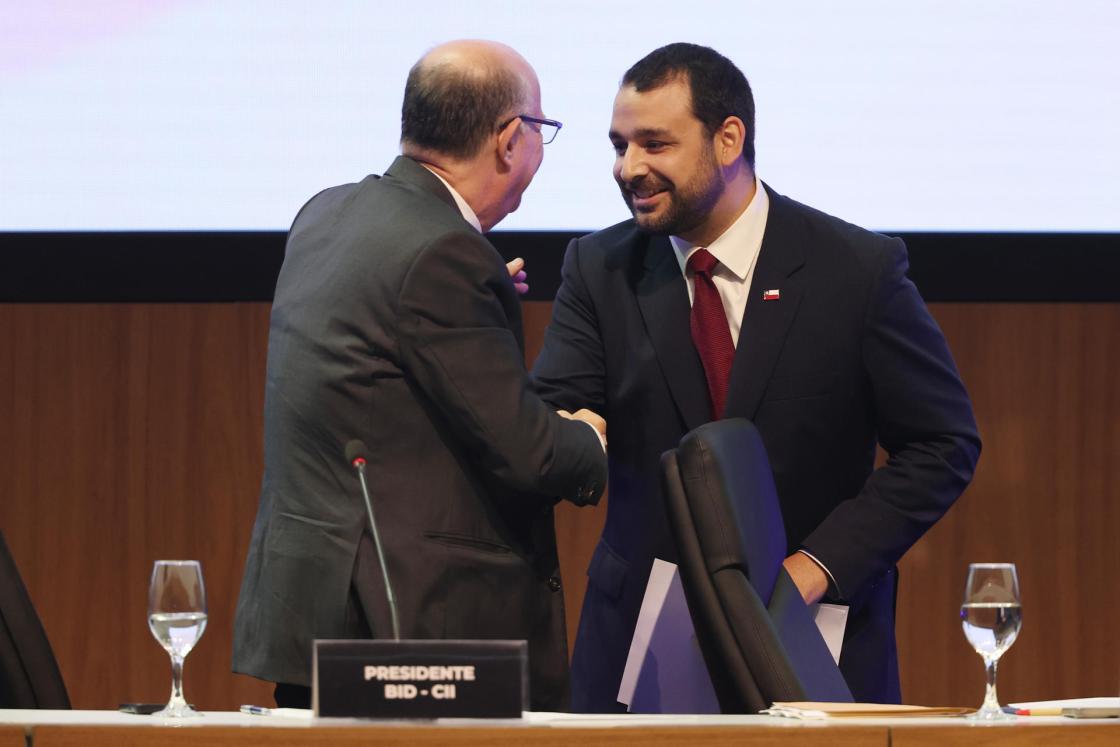
At the opening plenary session held on Friday, Paraguay’s Minister of Economy and Finance, Carlos Fernández Valdovinos, was elected the new chair of the IDB Group’s Board of Governors.
The outgoing chair, Chile’s Deputy Finance Minister Juan Pablo Rodríguez, praised the initiatives implemented since the meetings held last year in Santiago, many of which were created during the 2024 annual meetings in Punta Cana.
Rodríguez emphasized that the institution has managed to move “from the ‘what’ to the ‘how’” in implementing IDBImpact+, the initiative that integrates the work of the group’s three branches.
For his part, Fernández Valdovinos said that this is the “moment to consolidate those advances,” noting that the region is gaining “renewed global relevance” and possesses assets, from natural and food resources to a clean energy matrix, that place it in a privileged position and allow it “to be part of the solution to global challenges.”
“The central challenge of our region is one: to translate the potential we have today into realities into sustained growth, productive investment, and real well-being for all our citizens,” he said.
In his remarks, IDB Group President Ilan Goldfajn welcomed the successful capitalization of IDB Invest announced during the meetings in Paraguay, as well as the ongoing process to create a new Civil Society Engagement Strategy to further improve the impact of the institution’s financing. EFE

