
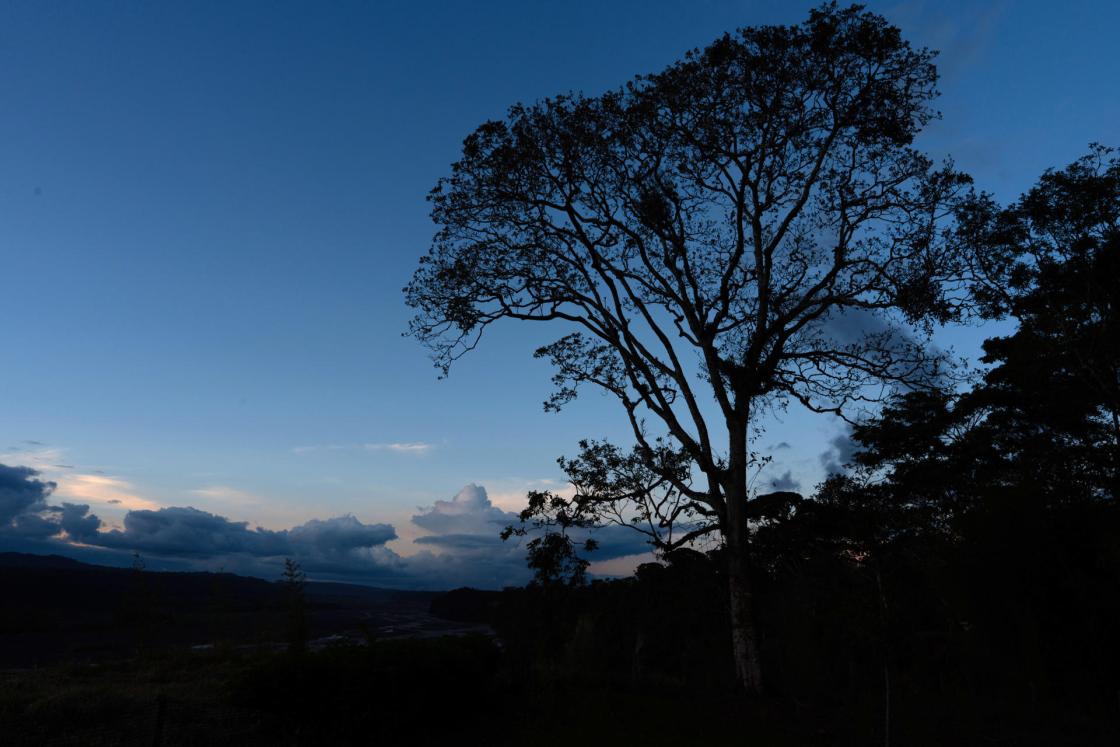
Kuchants (Ecuador), Oct 31 (EFE).- With more than 2,300 hectares undergoing restoration, Amazonian forests are being revived in degraded areas of Ecuador to curb climate change, protect endangered species, and provide new sustainable livelihoods for the indigenous communities who live there.
Cedars, palm trees, and guayacans are some of the tree species that are growing back in areas that had been deforested for years, as part of the REDD+ Results-Based Payment Project and the National Landscape Restoration Project (PNRP), focused on contributing to a reduction in greenhouse gas emissions by decreasing deforestation, the country’s main source of emissions.
The initiative, led by the Ecuadorian Ministry of Environment and Energy (MAE) with support from the United Nations Development Program (UNDP), is being carried out simultaneously in three different provinces in the country’s Amazon region.
These include 1,000 hectares in Zamora Chinchipe, 688 in Pastaza, and 668 in Morona Santiago, which have received support from partners such as the NGOs Hivos, the Reforestación Pastaza Consortium, and the Arcoíris Ecological Foundation, respectively.
In the community of Kuchants, home to the Shuar indigenous people in Morona Santiago, Domingo Najandey told EFE that “Ecuador can be an example to the world. (…) We can tell the world that we are conserving the Amazon.”
“Before, my territory was just farmland. We only had one variety (of crop). It was cassava or plantain. Now we are planting different varieties, including citrus fruits, cinnamon, and guayusa. We plant technically and manage our land sustainably,” said Najandey.


167,000 trees planted
The initiative has enabled the construction and upgrading of fourteen local nurseries, the planting of more than 167,000 native species, and the strengthening of 15 local enterprises that are boosting the economy, creating green jobs, and empowering communities.
Around 800 people are involved in the restoration and conservation of the areas covered by the project, which is indirectly benefiting 14,750 people, including Rosalba Vargas, from the Chuya Yaku community of the Kichwa indigenous people.
“If we go back in time, the forest where I live was full of medicinal plants and trees, and that was cut down, but thanks to these projects, we have reforested and planted plants that have allowed us to recover it,” said Vargas.
Goal exceeded
Seven indigenous communities are working on nearly 600 hectares, implementing sustainable practices in productive systems such as pastures, traditional agroforestry methods (chacras), and natural regeneration processes.
On Wednesday, an event was held in Kuchants to celebrate exceeding the 2,000-hectare goal set for this initiative, with an exhibition of products and handicrafts made by the communities.
“There are other countries in the world that are also restoring on a large scale, but what sets Ecuador apart, a country unique for its biodiversity, is that we are restoring in three provinces of the Amazon at the same time, with a link to REDD+ public policy, and with the involvement of local communities and indigenous peoples,” said Claire Medina, UNDP Deputy Resident Representative in Ecuador.
“When there is cooperation and partnerships, nature-based solutions to climate change can be sought, such as landscape restoration, livelihoods, and cooperation with local communities,” Medina said. In addition, this model in Ecuador has also secured 134,000 hectares of sustainable, deforestation-free crops, such as coffee and cocoa, which have already been exported to Europe.
Ecuador’s National Landscape-Based Ecological Restoration Plan covers a total of more than 24,000 hectares under this approach, and “every plant and hectare in the process of restoration is part of international commitments and national goals (for carbon emission reduction),” said Milton Ordóñez, director of forests at the Ecuadorian Ministry of Environment and Energy.