Brussels, Jun 22 (EFE).- Kazakhstan is seeking to deepen its relationship with the European Union during President Kassym-Jomart Tokayev‘s visit to Brussels this week, where cooperation on critical raw materials, energy supplies and other strategic issues will be discussed as the EU looks to diversify suppliers.
During his visit to Brussels on Monday and Tuesday, Tokayev is to meet with European Council President António Costa on the 10th anniversary of the Enhanced Partnership and Cooperation Agreement between Kazakhstan and the EU, the first agreement of its kind signed between the bloc and a Central Asian country.
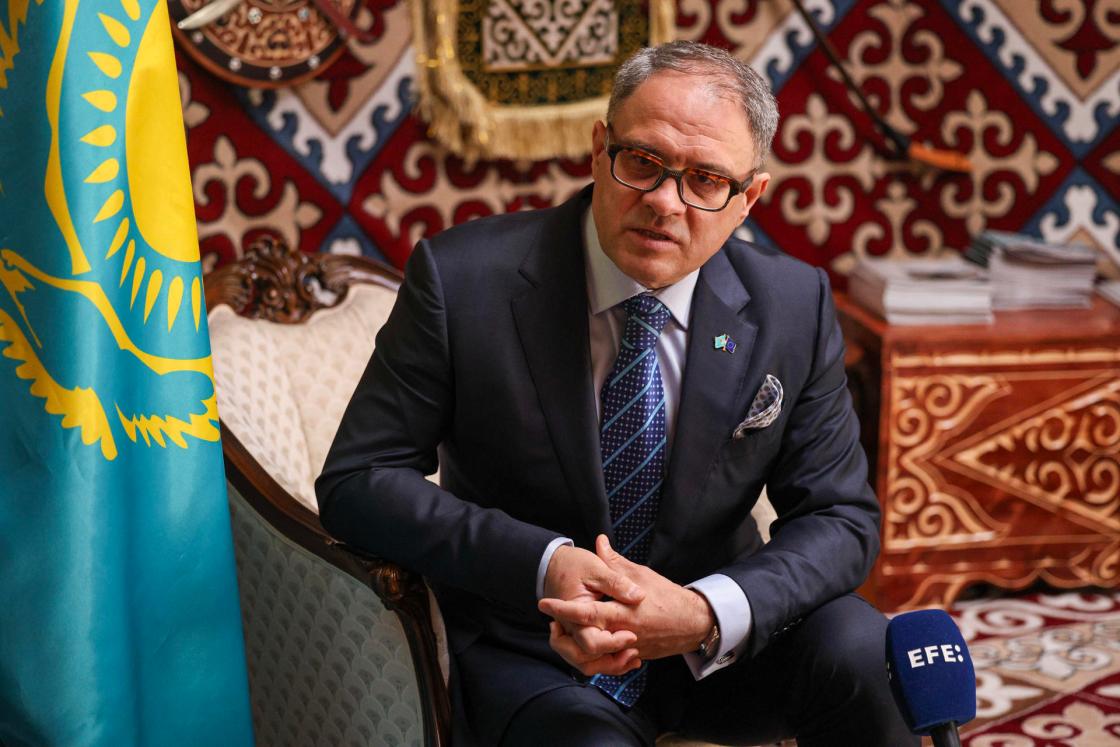
Kazakhstan and the EU “have come a long way with successful cooperation,” Kazakh Ambassador to Belgium Roman Vassilenko told EFE in an interview ahead of the visit. He said that both sides are working to “an even closer relationship, an even stronger relationship” in new areas.
Raw materials and energy
The Central Asian nation, one of the EU’s main energy suppliers and its third-largest crude oil exporter, believes it has significant potential to provide green hydrogen—one of the clean energy sources promoted by Brussels—as well as critical raw materials, in line with the EU’s objective of reducing its dependence on powers such as China.
In this context, Kazakhstan is developing the so-called Middle Corridor, a multimodal transport and logistics network that will directly connect China and Southeast Asia with the EU. Its geopolitical importance lies in bypassing Russian territory—affected by sanctions on Moscow—as well as bottlenecks such as the Suez Canal and the Red Sea.
The EU has invested around €12 billion in infrastructure projects across Central Asia, including the corridor, through its Global Gateway initiative, promoted by Brussels as a way to counter Beijing’s growing influence in the region and around the world.
From Kazakhstan’s perspective, however, Global Gateway and China’s Belt and Road Initiative are both welcome and should not be viewed as competing projects but rather as initiatives that “complement each other,” Vassilenko said.


European sanctions and dialogue with Moscow
The European Commission recently proposed its 21st package of sanctions against Russia, a new round of pressure measures that could affect companies based in Kazakhstan.
Asked about the issue, Vassilenko, who also heads Kazakhstan’s mission to the EU, stressed that although Astana has not joined the sanctions regime against Russia, it “does not want its territory to be used to circumvent” those measures.
“We have a very robust, frank, open dialogue with the European Union” on this matter, he said.
Regarding the war in Ukraine and ongoing contacts between various actors and Russia aimed at reaching a future peace agreement, the ambassador emphasized Kazakhstan’s commitment to diplomacy. His nation is “very concerned” about the conflict and its willingness to contribute to peace efforts.
“We are a country that maintains good relations with Russia, the European Union, the United States, and Ukraine. We can play a role if we are asked to contribute. And we have tried to keep all the channels of communication open. Indeed, there are conversations on this issue that take place between our president and global leaders,” the Kazakh diplomat said.
Human rights and political reforms in Kazakhstan will also be on the summit’s agenda. A new constitution, approved by 87% of voters in a referendum, is scheduled to enter into force on July 1.
According to the diplomat, the reform aims to “rebalance powers between the presidency and parliament while placing the protection of human rights as the state’s highest priority.” He added that the measure “has received a very constructive assessment” from European partners. EFE