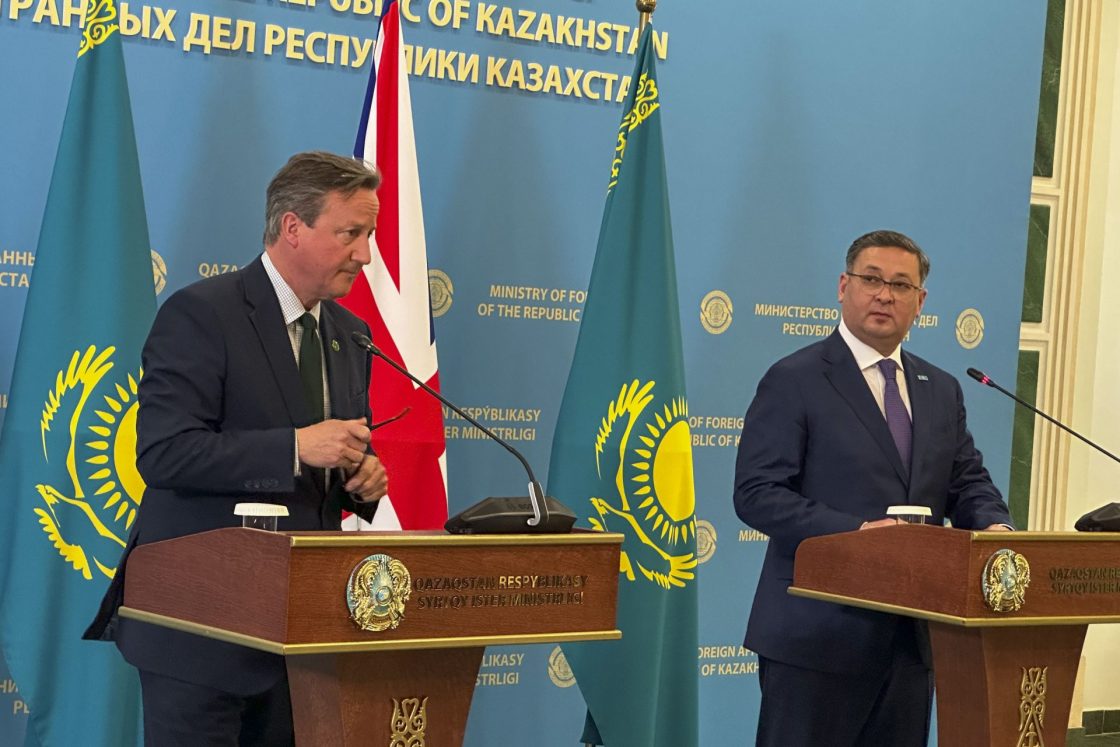
Astana, April 24 (EFE).- Kazakhstan’s Foreign Minister, Murat Nurtleu, and his British counterpart, David Cameron, signed a strategic partnership and cooperation agreement on Wednesday in the Kazakh capital.
The document, which took six years to develop, aims to strengthen relations in key areas such as trade and investment, human rights, energy and mining, environmental and climate change, science, and education.
“Over this period, much has been achieved in many fields, particularly in education. Today, I am pleased to announce our intention to double the number of Chevening scholarships available to young Kazakhs,” Cameron stated during a joint press conference with Nurtleu following the signing.
He highlighted successful cooperation examples in the oil and gas sector and assured that the British government would do everything possible to remove barriers to investment in the Kazakh economy.
“It’s a large region that includes Russia, China, Iran, and Afghanistan. There are many global challenges that we addressed today. And importantly, I want to emphasize that the United Kingdom seeks to be your partner, your partner in education and in providing opportunities for your youth, in business, and in other areas for your prosperity,” Cameron said.

Nurtleu noted that the United Kingdom is one of Kazakhstan’s most important partners and investors.
He pointed out that since Kazakhstan declared its independence in December 1991, British investments in the country have totaled $17 billion.
The Kazakh minister added that in 2023, trade between the two countries reached $1.2 billion, marking a 20 percent increase from the previous year.
Kazakhstan considers that a promising area for cooperation with the United Kingdom could be joint mining, particularly in the extraction and processing of rare earth elements.
Cameron arrived in the Kazakh capital this Wednesday as part of a tour of the former Soviet republics in Central Asia and Mongolia.
Following his meeting with his Kazakh counterpart, the head of the Foreign Office was received by the President of Kazakhstan, Kassym-Jomart Tokayev.
He is also set to hold talks with Kazakhstan’s Minister of Science and Higher Education, Sayasat Nurbek.
According to London, Cameron’s Central Asian tour demonstrates the British government’s intent to “increase its engagement with this crucial region of the world.” EFE