
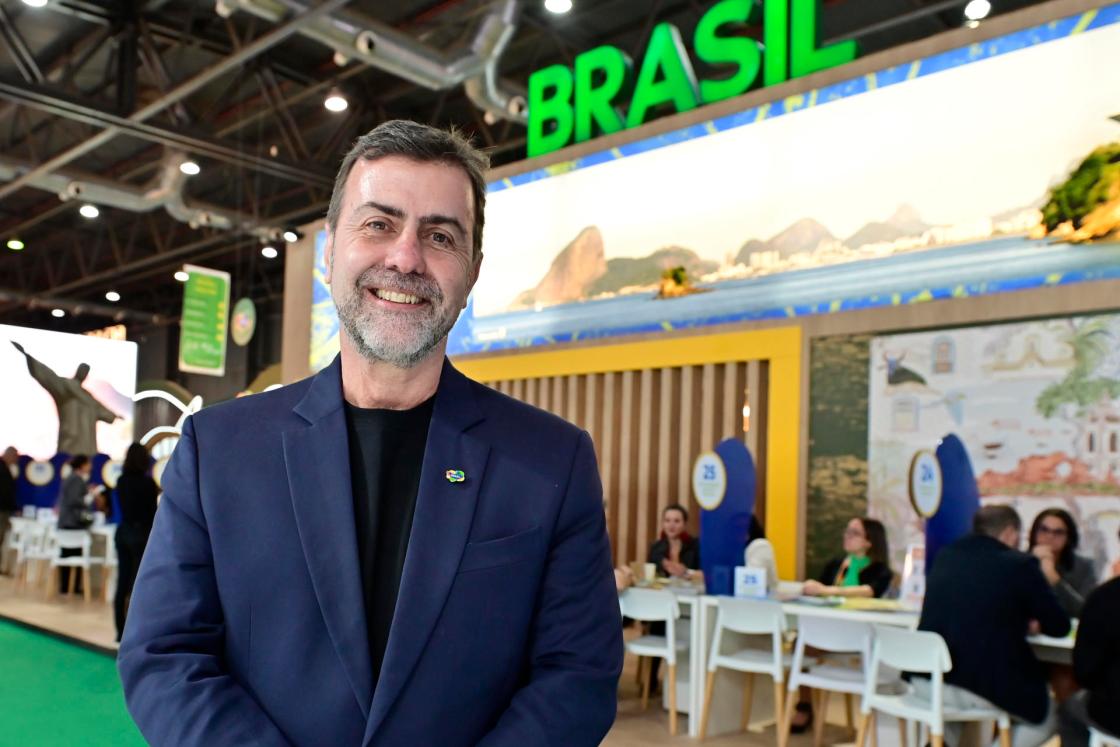
Buenos Aires, Oct 1 (EFE).— Marcelo Freixo, president of the Brazilian Agency for International Tourism Promotion (Embratur), highlighted the record growth of Brazil’s tourism industry since 2023, declaring that “in the 21st century, tourism makes more sense than oil.”
Speaking to EFE on the sidelines of the Latin American International Tourism Fair (FIT 2025) in Buenos Aires, Freixo explained that under President Luiz Inácio Lula da Silva, Embratur built “a technical team specialized in tourism with strong management and planning capacity.”
Brazil is the featured country at FIT 2025, with 26 stands showcasing the country’s diversity—particularly destinations in the northeast, such as Alagoas, Bahia, and Pernambuco, which remain less known to Argentines.

Data-driven growth
Freixo emphasized that data intelligence now underpins all of Brazil’s tourism policies.
“We know which markets are interested in Brazil, the average spending, the peak travel seasons, and that allows us to plan much more efficient promotional actions,” he said.
That strategy helped international tourism generate $6.9 billion in 2023, surpassing revenues from the 2014 World Cup. In 2024, the figure climbed to a record $7.3 billion with 6.7 million foreign visitors.
“It means jobs, income, growth, and a major economic boost for the entire country,” Freixo stressed.
Tourism now represents 8% of Brazil’s GDP, compared with 12% for oil and gas.
“I believe that in the 21st century, tourism makes more sense than oil, especially if we think in terms of sustainability and climate responsibility,” he said.
Tourism boom led by Argentina
In the first seven months of 2025, tourism in Brazil increased 46% year-over-year, with Argentine arrivals jumping 94%.
“To give an idea, in 2024 we had 1.9 million Argentines in Brazil, and by August this year we already had 2.6 million,” Freixo noted.
Asked if the Brazilian strategy could be applied elsewhere, he said that while each country has “its own circumstances and political moments, the path of planning and data intelligence is good for everyone.”

Diversity and traditional cultures
At FIT, Brazil aimed to differentiate itself from the Caribbean by emphasizing its cultural and natural diversity.
“We don’t just have beaches; we have six different biomes, with very distinct cultures and cuisines. Each region expresses its own identity,” Freixo explained.
Examples range from feijoada in Rio de Janeiro, to moqueca and bobó de camarão in the north, and açaí-based dishes in the Amazon.
The campaign also highlights Amazon tourism and the heritage of quilombos—settlements founded by Africans who escaped slavery, which became centers of political organization and cultural resistance.
For Freixo, this represents “community-based, reparative tourism, with a strong commitment to history and traditional populations, tied to a sense of social justice.”
He stressed that while Brazil has luxury hotels and exclusive resorts, there are also community-led experiences that strengthen local economies.
“People need a legal economic activity to counter illegal ones, and tourism is a very important possibility for those communities,” he said. EFE
EFE produced this content with the support of Embratur.