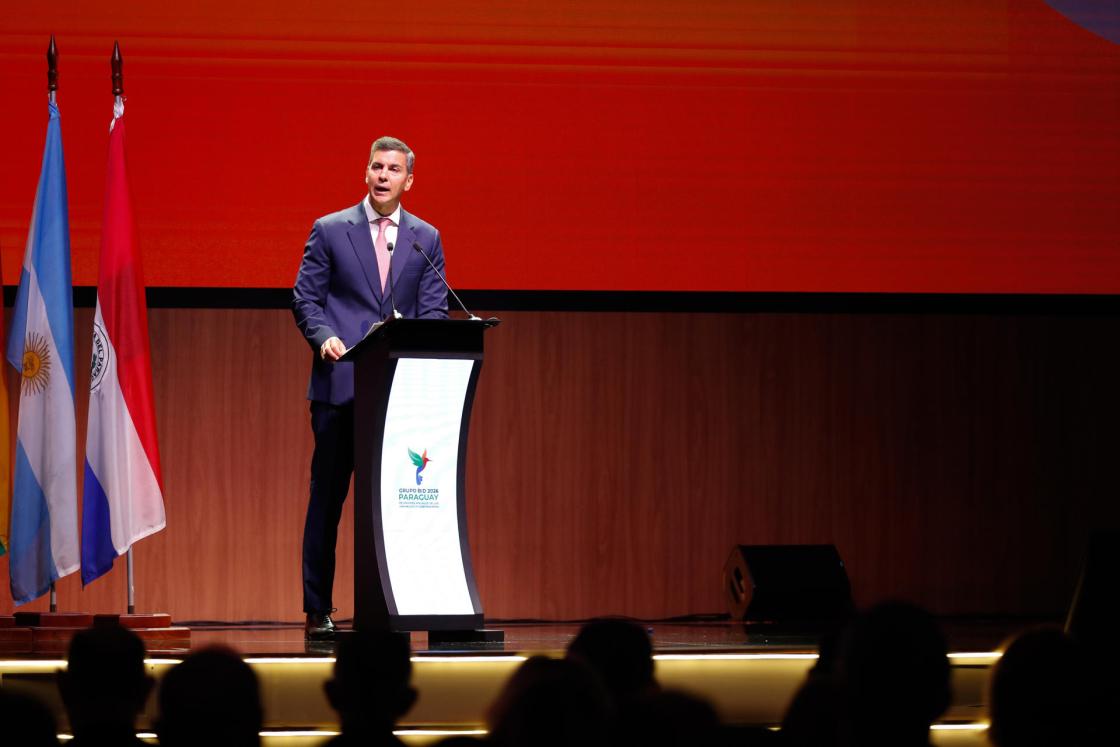
Luque (Paraguay), Mar 13 (EFE).- The trade agreement between Mercosur and the European Union dominated the opening of the third day of the Inter-American Development Bank (IDB) Group’s annual meetings in Paraguay on Friday, at an event attended by senior representatives from both blocs who highlighted its potential as a catalyst for investment and growth.
Paraguayan President Santiago Peña said that, despite the quarter century it took to sign the agreement, the fact that the two regions that “share values” were able to reach such a consensus “sends a very important signal to the world.”
Peña noted that his country has learned that “sustainable growth is deeply linked to quality and openness to the world,” and that, for this reason, Asunción understands “this agreement not only as a trade opportunity, but as an opportunity for economic transformation.”
The Paraguayan leader acknowledged that “international agreements alone do not generate development,” but that they do “open doors.” He also praised IDB’s support in helping the country grow “better” through initiatives that encourage improving standards, investing in infrastructure, strengthening human capital, and supporting companies, especially small and medium-sized businesses, “so they can take advantage of the opportunities that arise.”
In that regard, IDB President Ilan Goldfajn said during the symposium that the institution is “the only multilateral bank with members from both Mercosur and the EU,” and therefore serves as a “natural bridge” and a strategic facilitator in the current context.
Peña emphasized his government’s commitment to supporting the growth and development process that will come with the trade deal by implementing public policies to invest in infrastructure, technical training, and digitalization, and above all by establishing strong institutions “to provide legal certainty for those who invest.”


The key role of the private sector
At the same time, he stressed that ultimately “companies, entrepreneurs, and investors are the ones who turn opportunities into real growth.”
Paraguay’s Minister of Economy and Finance, Carlos Fernández Valdovinos, his country’s governor at the IDB Group, agreed with that perspective, saying that the public administration “prepares the field,” but “the private sector is the one that plays the game.”
For his part, European Commissioner for Trade Maroš Šefčovič congratulated Asunción, in a prerecorded video message, for carrying out a rapid approval process for a treaty that will create a common market of “720 million consumers” and will be highly useful at a time of “growing global unpredictability.”
Paraguayan Foreign Minister Rubén Ramírez Lezcano, who also participated in the event alongside the foreign ministers of Brazil and Uruguay, Mauro Vieira and Mario Lubetkin, and Argentina’s Secretary for Production Coordination, Pablo Lavigne, said that, following the expected approval in parliament on Tuesday, the agreement will be fully ratified by March 31 to enter provisional implementation in Paraguay.
Lubetkin, for his part, highlighted the willingness shown by the four Mercosur member countries, despite their differing political agendas, to sign a trade deal that aims to eliminate 90% of tariffs applied to trade between the two blocs and create the world’s largest free trade zone.
Lavigne, in turn, called for true “regulatory harmonization” within Mercosur itself so that small and medium-sized enterprises in its four member countries face far fewer obstacles at their respective customs checkpoints. EFE


