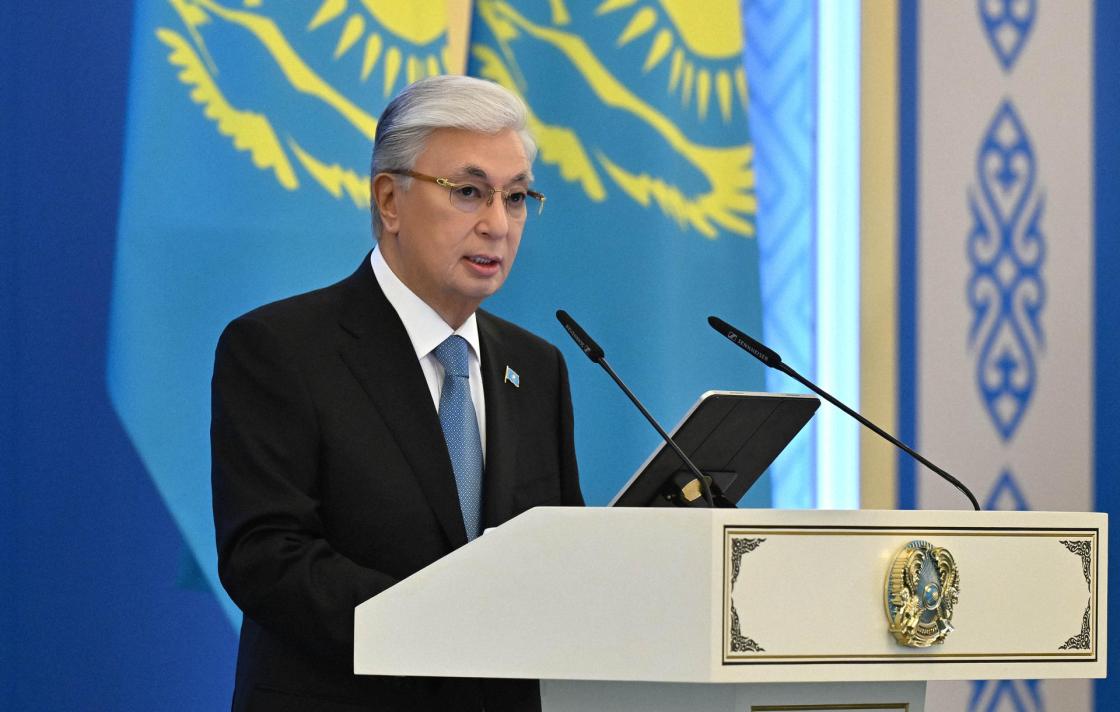
Kazakh President Kassym-Jomart Tokayev on Wednesday called on citizens to unite amid mounting international volatility during his first state-of-the-nation address before the country’s new unicameral parliament, the Kurultai.
“It would be an exaggeration to say that the entire world community is living in turbulent times. Such a complex and unpredictable situation was not seen even during the Cold War,” Tokayev told the Kurultai, established following legislative elections in August.
The Kazakh leader warned that “false accusations and hidden conflicts have intensified among the countries of the world, and a massive crisis of mutual trust has arisen among the giant, influential states.”
Tokayev highlighted the eroding authority of key international bodies as one of today’s serious challenges, pointing specifically to the United Nations, which he said “has suffered a major setback” while “the value of international law has declined.”
He said, “Uncontrolled, irregular migration flows have increased significantly, causing great harm to the security of several European countries.”
According to the head of state, the world has entered “a murky era, and there is no consensus among politicians and experts about what its future holds.” In response, he called on the Kazakh people to strengthen national unity, linking the country’s progress to “order and discipline in our society.”


Infrastructure projects
Against this backdrop, Tokayev urged lawmakers to make the Central Asian nation “one of the leading logistics centers in Eurasia,” citing the growing vulnerability of maritime trade routes due to the war in Ukraine and the ongoing transformation of global supply chains.
He also called for breaking ground in 2027 on Kazakhstan’s first nuclear power plant, a project led by Russian specialists, while establishing strategic uranium reserves to secure its long-term operations and raising electricity generation to produce a surplus by 2029.
Among other domestic measures, Tokayev directed authorities to raise the minimum wage by nearly one-third to 110,000 tenge ($240), debate higher taxes on the wealthy, and draft a new civil code aligned with the country’s evolving economic landscape. EFE