
Brazil, one of the world’s largest exporters, is seeking to diversify its markets and increase its competitiveness to continue expanding globally — and for that, it is focusing on the trade and investment potential of Southeast Asia.
With a free-trade area comprising 11 countries and more than 690 million inhabitants, the Association of Southeast Asian Nations (ASEAN) was Brazil’s third-largest export destination in 2024, accounting for 7.8% of the country’s total 337 billion dollars in foreign sales.
Although Brazilian exports to ASEAN grew at an average annual rate of 17.3% — above the country’s overall export growth of 8.8% in the same period — these numbers are still below the region’s potential, according to the Brazilian Trade and Investment Promotion Agency (ApexBrasil).
In terms of foreign direct investment in Brazil in 2024, 17.2 billion dollars originated from ASEAN members, just 1% of the bloc’s total investments abroad.
Given this scenario, ApexBrasil’s president, Jorge Viana, said in a statement that it is essential for Brazil to strengthen ties with strategic partners at a time when “global economic relations are undergoing major transformation.”
“I have no doubt that trade with the region is on track to grow. There is enormous potential for Brazilian investors in Southeast Asia — and equally for investors from there in Brazil,” he said on social media.
CHALLENGES AND OPPORTUNITIES
The agency identified nearly 2,000 export opportunities for Brazilian products within the bloc.
With an export profile still concentrated in commodities — especially oil, iron ore, and agricultural products — Brazil aims to surpass its current 10th position among ASEAN’s top foreign suppliers.
“ApexBrasil is committed to ensuring that this new cycle of opportunities reaches all regions of the country, including the Amazon,” Viana stressed.
A major challenge, however, is outperforming China and the United States, the country’s main competitors in key sectors such as fuel oil and soybean meal, according to an ApexBrasil study.
Another significant obstacle for Brazil to fully tap into Southeast Asia’s potential is the bloc’s heterogeneity. ASEAN consists of countries with very different income levels, regulations, and bureaucratic systems, which requires tailored strategies for each market.
The report highlights that Singapore functions as a logistics hub; Vietnam and Thailand serve as industrial bases; Indonesia and the Philippines are large-scale consumer markets; while Malaysia and Brunei are upper-middle-income economies focused on technology and energy.
A STRATEGIC MISSION
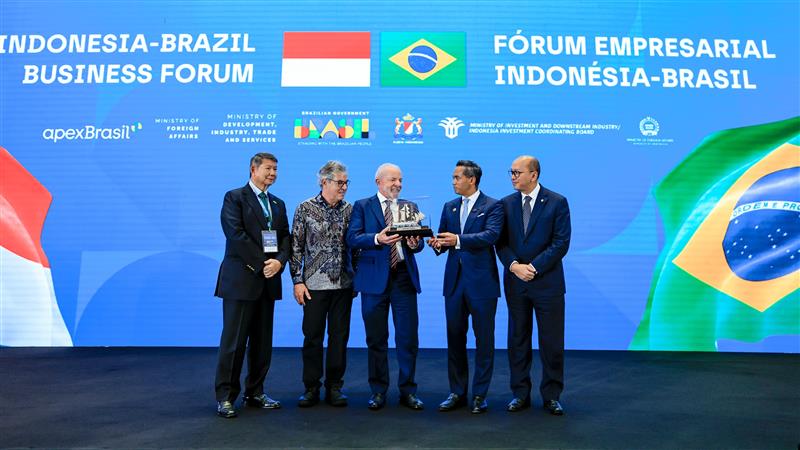
To strengthen Brazil’s role in economic integration with ASEAN, ApexBrasil and the Ministry of Foreign Affairs organized a business mission to Indonesia and Malaysia in October, which also included the participation of President Luiz Inácio Lula da Silva.
After Singapore, Indonesia and Malaysia are Brazil’s most strategic partners in terms of investment volume, export destinations, business presence, and future expansion potential.
Viana, who joined the Asian mission alongside nearly 150 Brazilian business leaders, described the trip as a “unique opportunity” to bring “the strength and diversity of Brazil’s productive sector to engage with local governments and businesses, identify partnerships, and open doors for our products.”
During the visit, a partnership agreement was signed in Jakarta between Indonesia Energy Corporation (IEC), Aguila Energia e Participações, and ApexBrasil to develop pilot hybrid energy-generation projects in northeastern Brazil, with initial investments exceeding 56 million dollars.
“This partnership reflects Brazil’s new moment as a protagonist in the energy transition and digital economy,” Viana stated.
During the meeting in Indonesia, seven additional memorandums of understanding were signed between government bodies and private-sector organizations from both countries, covering areas such as agriculture and livestock, mining and energy, science and technology, geography and statistics, and investment cooperation.
“The closer relationship between Brazil and Indonesia — two major economies of the Global South — paves the way for innovative, sustainable, and strategic projects capable of generating jobs, regional development, and clean technology,” he concluded. EFE