
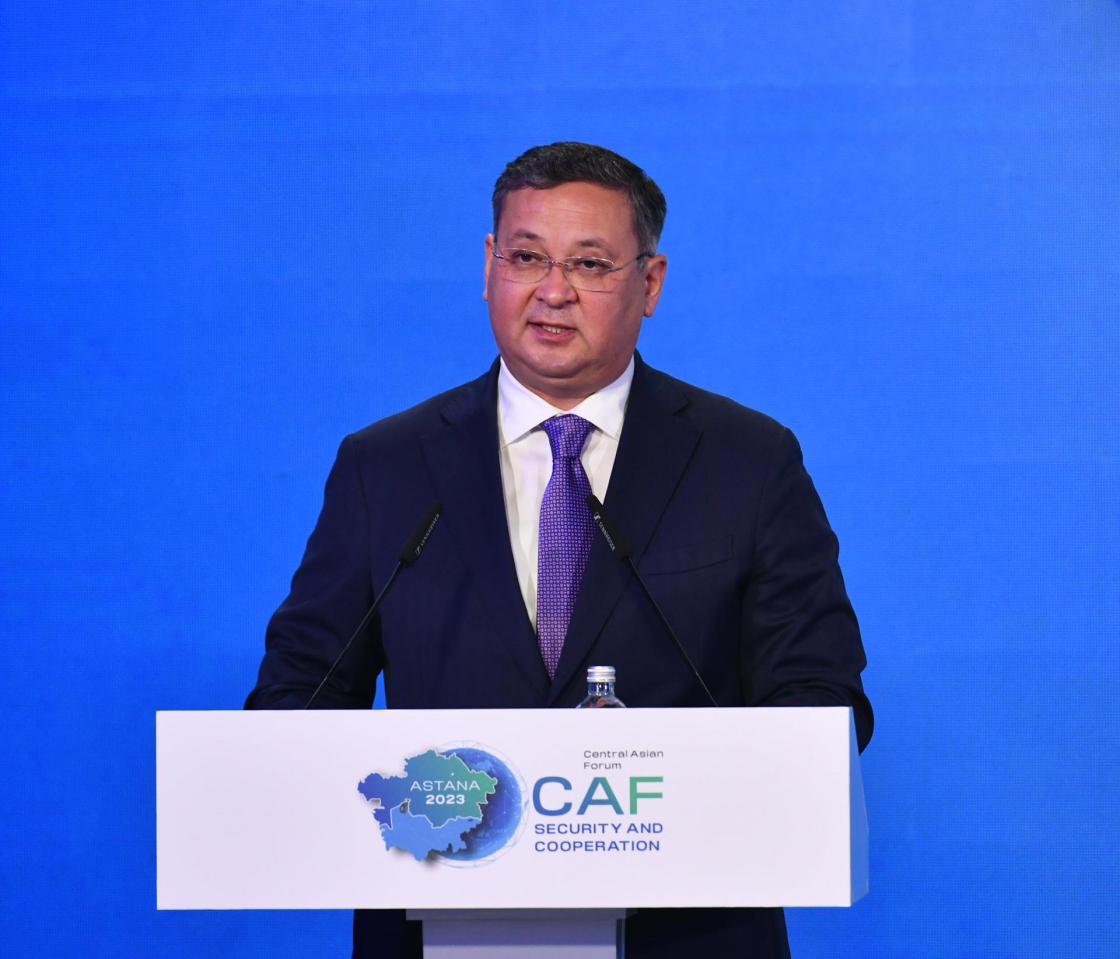
Astana, Jul 13 (EFE).- The Deputy Prime Minister and Minister of Foreign Affairs of Kazakhstan, Murat Nurtleu, inaugurated on Thursday the first Central Asian Forum on Security and Cooperation (CAF), an event gathering prominent experts to discuss geopolitical challenges and opportunities in Asia.
In his opening remarks, Nurtleu read a welcome message from Kazakh President Kassym-Jomart Tokayev highlighting the urgent need for open dialogue in the face of rising geostrategic tensions, economic uncertainty, and eroding foundations of international relations.
“Any systemic crisis, however, in addition to creating a wide range of threats, also brings with it new unique opportunities, including for Central Asia. It is therefore important for us to focus our efforts on seeking constructive ideas and effective approaches to building a more safer and just world,” Tokayev said in his message.
The Kazakh president stressed that an optimal model of sustainable regional development should be based on three interrelated elements: an effective public administration system, a competitive market economy, and a socially responsible inclusive society.
“As we seek to comprehend our region’s mission in the modern world, we should, first of all, proceed from common intrinsic security interests and an unwavering aspiration towards comprehensive cooperation on the path toward sustainable progress,” Tokayev told the forum in his message.
Emphasizing Asia’s role in global affairs, Nurtleu acknowledged persistent regional issues such as chronic conflicts, distrust, and socio-economic disparities. He voiced his country’s commitment to a balanced, constructive foreign policy based on UN Charter principles and international law. In response to these challenges, Nurtleu affirmed Kazakhstan’s determination to enhance Asia’s peaceful, long-term development by investing in economic welfare, cultural enrichment, and education.
Nurtleu highlighted Kazakhstan’s internal reforms under President Tokayev’s leadership, making strides toward a just, fair society. He expressed the Kazakh Government’s commitment to continue wide-ranging democratic transformations and economic modernization, recognizing these as the nation’s best path to success.
The Foreign Minister asserted Central Asia’s integral role in Asia. A dynamically developing region with a $350 billion GDP, Central Asia has the potential to be a Eurasian transport and logistics hub, Nurtleu argued, promoting regional interaction through various initiatives. He noted the importance of the 2022 Treaty on Friendship, Good-Neighborliness and Cooperation for the Development of Central Asia in the 21st Century.
Nurtleu dismissed the outdated concept of a new “Great Game,” proposing a “Great Gain” to amplify opportunities for mutually beneficial cooperation. He suggested utilizing Central Asia’s potential as a transport hub, partnering with global initiatives such as China’s Belt and Road Initiative, the EU’s Global Gateway initiative, and the G7’s Partnership for Global Infrastructure and Investment.
Addressing regional challenges, Nurtleu spotlighted water and environmental issues, border disputes, and the situation in Afghanistan. He proposed a Regional Water and Energy Consortium and voiced support for peaceful negotiations to resolve border disputes.
He also stressed the importance of international support for a united and inclusive Afghan government under the central coordinating role of the UN, advocating for establishing a UN Regional Hub for Sustainable Development in Central Asia and Afghanistan in Almaty.
Finally, Nurtleu highlighted Kazakhstan’s commitment to nuclear non-proliferation and disarmament, promoting the expansion of Nuclear-Weapon-Free Zones to other regions, especially Asia, and the elimination of nuclear weapons by 2045.
As Asia continues to stand as a beacon of hope and opportunity, Nurtleu asserted that Central Asia’s growing global role could be a source of stability, interconnectivity, and security, committing Kazakhstan to a proactive mutually-beneficial approach to regional development. EFE