
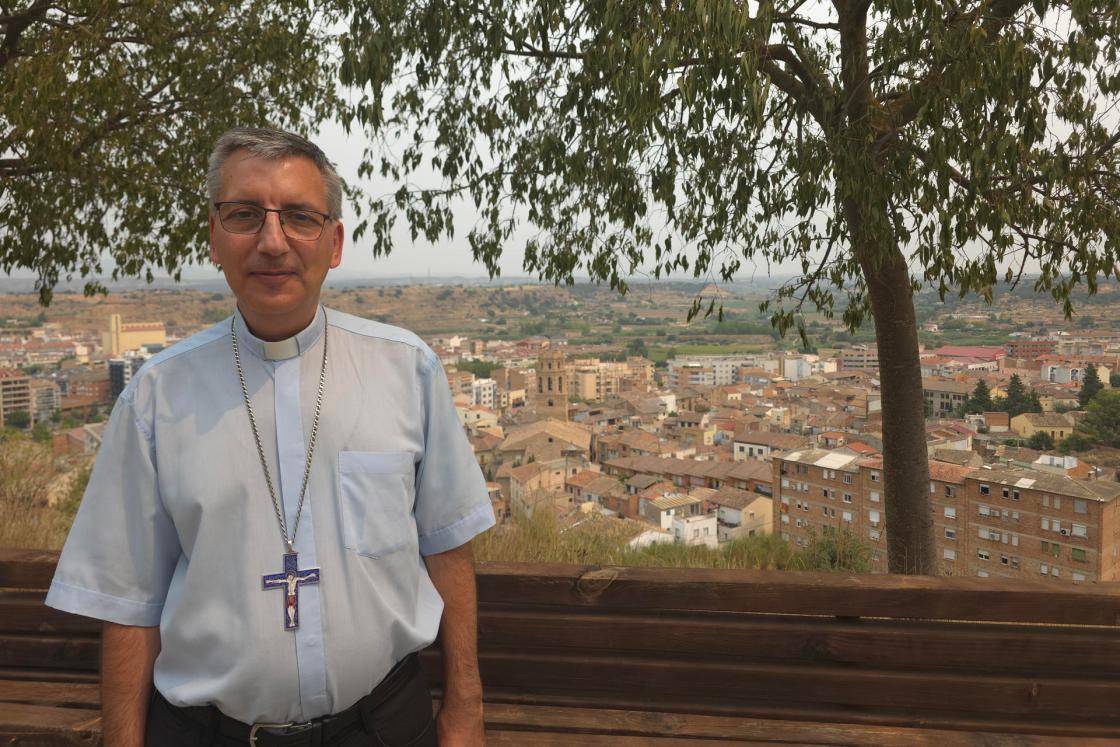
Astana, Aug 26 (EFE) – The Catholic community in Kazakhstan has undergone a radical transformation in the three decades since the country’s independence and now includes members of all the ethnic groups living in the nation, Spanish Bishop José Luis Mumbiela Sierra told EFE.
“The face of Kazakhstan’s Catholic population is multiethnic,” said Mumbiela, bishop of the Holy Trinity Diocese in Almaty and president of the Episcopal Conference of Central Asia, less than a month before Kazakhstan hosts the 8th Congress of Leaders of World and Traditional Religions.
Three decades of change since independence
The bishop explained that in recent years the community—whose history predates Kazakhstan’s Soviet period (1920–1991)—has grown to include “many people from non-Catholic and even non-Christian backgrounds.”
During the Soviet era, Catholics in Kazakhstan were largely Poles, Germans, and Balts deported to the region. But today, Mumbiela said, “the face of Catholics in Central Asia, and in Kazakhstan in particular, has changed a lot.”
On one hand, many Germans and Poles have left the region. On the other, “due to intermarriage, because authentic human love does not know religion,” the community has diversified.
Although the number of faithful has declined—there are an estimated 200,000 Catholics in Central Asia—Mumbiela stressed that the community’s evolution is “positive.” It is “more open, and better reflects what the Catholic Church is: it does not belong to one or two nationalities, but is universal, it is of all and for all.”
Since independence in 1991, the Catholic Church in Kazakhstan has expanded its organizational structure, establishing more parishes and religious institutions.
“We have grown in organization; we are more consolidated as a structure,” he said.
A Church serving society
Mumbiela particularly emphasized the Church’s “good relations with the Kazakh government.”
“A living church that seeks to be active must project itself not only for the benefit of Catholics, but also for the good of Kazakhstan, so as not to be a church that only thinks of itself, but one that is more capable of contributing something.”
Quoting Jesus, he added that the Kazakh Catholic community aims “to be the light of the world, like yeast in the dough, like salt that gives flavor to society—even if small in number, it has a big impact and helps everyone.”
On the war in Ukraine
Asked about the conflict in Ukraine, Mumbiela described it as “not a war between two countries, but a fratricidal war (…) a very sad reality, as all wars are.”
Although he said he was not the best person to analyze its causes, he explained the conflict stems from “a long history of disunity (…) a history sometimes fueled by hatred, a history in which people have not known how to live together, forgive, stay united and foster unity over division.”
“What we must do as Catholics is always seek what Pope Francis calls for: unity, peace, forgiveness, reconciliation, truth.”
“In war, no one wins because everyone loses—everyone has lost something: lives, friends, relatives, relationships, hopes, history. There are so many losses,” he added.
According to the bishop, Catholics in Kazakhstan are praying that “the tragedy of war ends soon. It is an unjust war and one that cannot be justified.”
Kazakhstan as a center for dialogue
Mumbiela praised Kazakhstan’s role as “a center for dialogue, a meeting place of cultures, as Pope Francis said” during his visit to Astana.
For that reason, he said it is timely to hold the Congress of Leaders of World and Traditional Religions on Sept. 17–18, describing the initiative as “very necessary.”
“This fosters peace. Kazakhstan, the spirit of Kazakhstan, is part of the solution for the future. Creating structures for dialogue benefits everyone.”
In that sense, he said Kazakh Catholics “may be few, but we can contribute something important.” EFE