
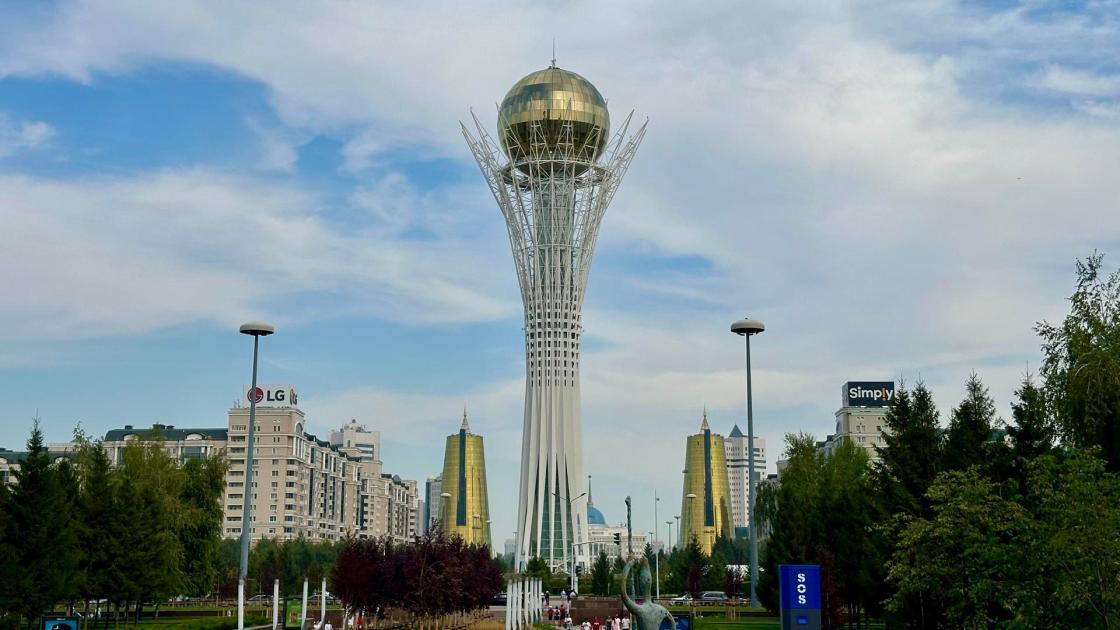
The Kazakh economy, the engine of Central Asia, has grown by more than 26% over the last seven years, despite the pandemic and four and a half years of war between its neighbor, Russia, and Ukraine.
The gross domestic product of Central Asia’s largest republic, led by Kassym-Jomart Tokayev since 2019, contracted only in 2020—by 2.6%—and grew by 6.5% last year and 4.1% in the first half of 2026. In the last seven years, nominal GDP has increased from $181.7 billion to approximately $306 billion, and per capita GDP has risen from $9,800 to $15,000, while external debt fell from $51 billion to $35 billion.
Geopolitical challenges
Landlocked isolation remains Kazakhstan’s weakest point, despite natural wealth that includes oil, gas, uranium, and other strategic minerals. Its land border with Russia spans over 7,500 kilometers (approx. 4,660 miles), and part of its export infrastructure traverses neighboring countries.
Russia, for its part, has been entangled in armed conflict for over four years, presenting a significant challenge for the Kazakh economy. The West demands that Moscow’s traditional partners refrain from helping it circumvent sanctions.
This vulnerability became particularly evident in 2026 following attacks on the Caspian Pipeline Consortium (CPC), which transports the majority of the country’s oil exports.
According to the Kazakh Minister of Energy, strikes on the infrastructure in Russian territory caused the oil industry to lose some 3.5 million metric tons of crude production.
For Kazakhstan, which also borders China, the current geopolitical environment—including tensions in the Middle East that have affected exports—has shown the vital importance of diversifying export routes to ensure economic stability.
From raw material extractor to processor
Given the tense geopolitical climate, Kazakh authorities are working to transform the economy by reducing reliance on raw material exports and increasing the manufacturing of goods of higher value.
A central focus is processing domestic resources. While the republic produces significant volumes of natural gas, a large part is extracted alongside oilfield operations. This fuel requires processing before distribution to consumers.
Amid rising domestic demand, limited processing capacity has driven extra gas imports from Russia, which could reach 11 billion cubic meters in 2026 despite Kazakhstan’s vast domestic reserves.
Authorities are applying the same strategy to the petrochemical industry, striving to transition from exporting raw materials to producing higher-value products. A crucial project in this sector is the construction of the Silleno plant in the Atyrau region, an estimated investment of $7.4 billion with a planned capacity of 1.25 million metric tons of polyethylene per year.
The project involves Kazakhstan’s KazMunayGas, China’s Sinopec, and Russia’s SIBUR. Additionally, a consortium between Spain’s Técnicas Reunidas and China’s Sinopec Engineering is constructing a pyrolysis plant.
Silleno exemplifies how Kazakh raw materials can be converted into petrochemical products for domestic and international markets. This shift allows for the gradual expansion of production chains and a move away from a legacy model for raw-material exports.
China and the EU
China is one of Kazakhstan’s major economic partners. Both countries are expanding trade, investment, energy, and transportation corridors, including a route across the Caspian Sea.
The European Union also remains a vital partner. In 2024, the EU accounted for 32.4% of Kazakhstan’s foreign trade. While hydrocarbons and natural resources form the core of exports, cooperation is extending into critical materials, energy, transport, and industrial projects.
In this regard, Central Asia’s largest republic expects to attract up to $150 billion in foreign investment through 2029 to expand national infrastructure and production capacity.
Another component of the ongoing economic restructuring is the development of artificial intelligence and digital technologies. The largest nation in Central Asia is working to establish its own digital infrastructure while acquiring foreign technology and expertise.EFE
By Kulpash Konyrova