
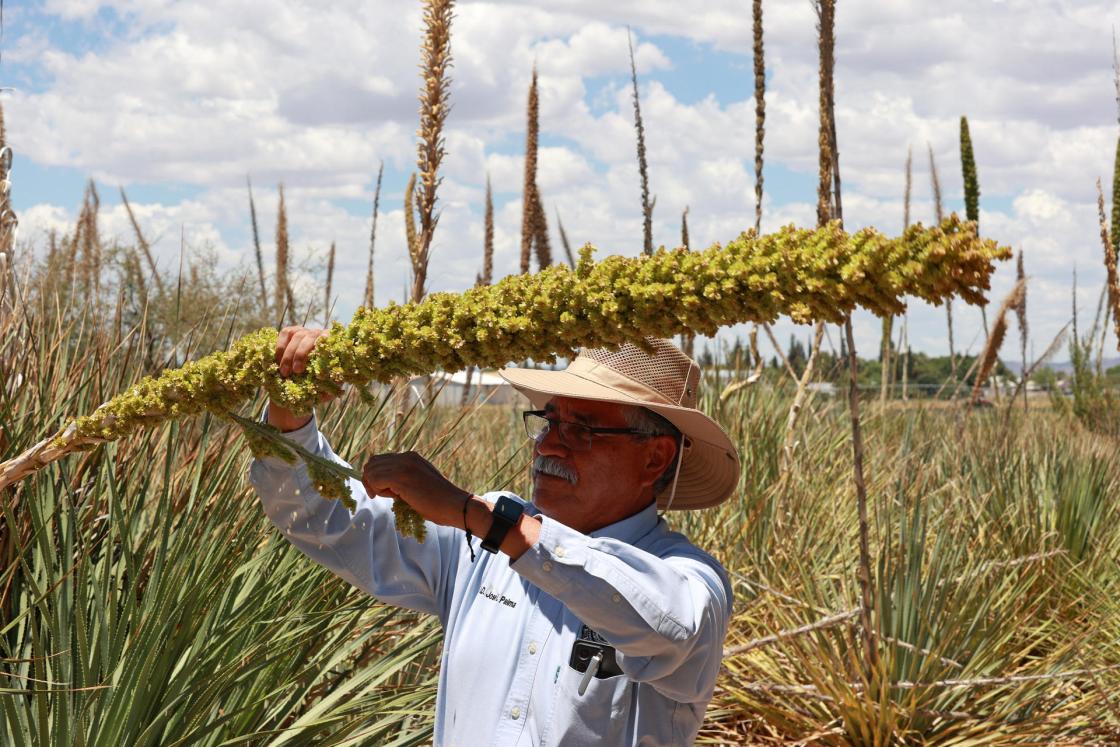
Delicias (Mexico), Jul 5 (EFE),- Under the sweltering sun, a “jimador” uses an ax to cut the thorny leaves of a plant weighing almost 40 kilos in the town of Delicias, in the northern state of Chihuahua. From it, sotol, the new sensation among fans of strong Mexican spirits, will be extracted.
The “jimador,” a specialized farm worker who harvests sotol plants, shows the core that will be cooked and later distilled into sotol. Access is complicated, as it only grows in the wild on the steep slopes of the extreme deserts of northern Mexico. There, temperatures are scorching during the day and freezing at night.
Despite this, its captivating allure has already charmed the palates of celebrities such as American actress Julia Roberts and musician Lenny Kravitz, both confessed lovers of the liquor.
One of the main sotol research centers is the Faculty of Agricultural and Forestry Sciences at the Autonomous University of Chihuahua (UACH). This pioneering center domesticated the plant for the first time in the late 1980s.
“We rescued the sotol from the danger of extinction at the end of the last century. And we opened the door to its commercialization,” explained Dr. José Inés Palma Escamilla, an academic at the faculty.


Protecting sotol
The word sotol or zotol comes from the Nahuatl word “tzotollin,” meaning “sweet of the head.” It is a traditional alcoholic beverage from the north of Mexico characterized by its spirit-making process. The indigenous communities in the region have safeguarded it for more than 800 years. The drink has a high alcohol concentration, which varies between 38 and 45 percent, and smoky and vanilla aromas.
From a commercial point of view, Chihuahua’s businesses consider that sotol has a great opportunity for development. They also stress the need to increase investment in technology.
Alfonso Lechuga is the head of the Chihuahua Agroindustry and Advanced Food cluster. He believes, stressing that it can follow in the footsteps of other successful beverages such as tequila and mezcal. Science and business must join forces, though.
“We have tequila that has decades of international recognition. Mezcal, I would dare say, took off 20 years ago. And then, in a slower way, goes sotol. But it is already here,” he told EFE.
For Lechuga, one of the obstacles to growth is that “there are few commercial plantations. As a result, it still makes it very expensive” and there is “a lot of diversity” among producers.
However, he said that they are taking steps in the right direction with the creation of a designation of origin regulatory council. The body is to be set up in the three states where it is grown: Durango, Coahuila, and Chihuahua. And it is in Chihuahua where 75% of total production is grown. EFE
EFE received support from Chihuahua Economic Development for the preparation of this article.