
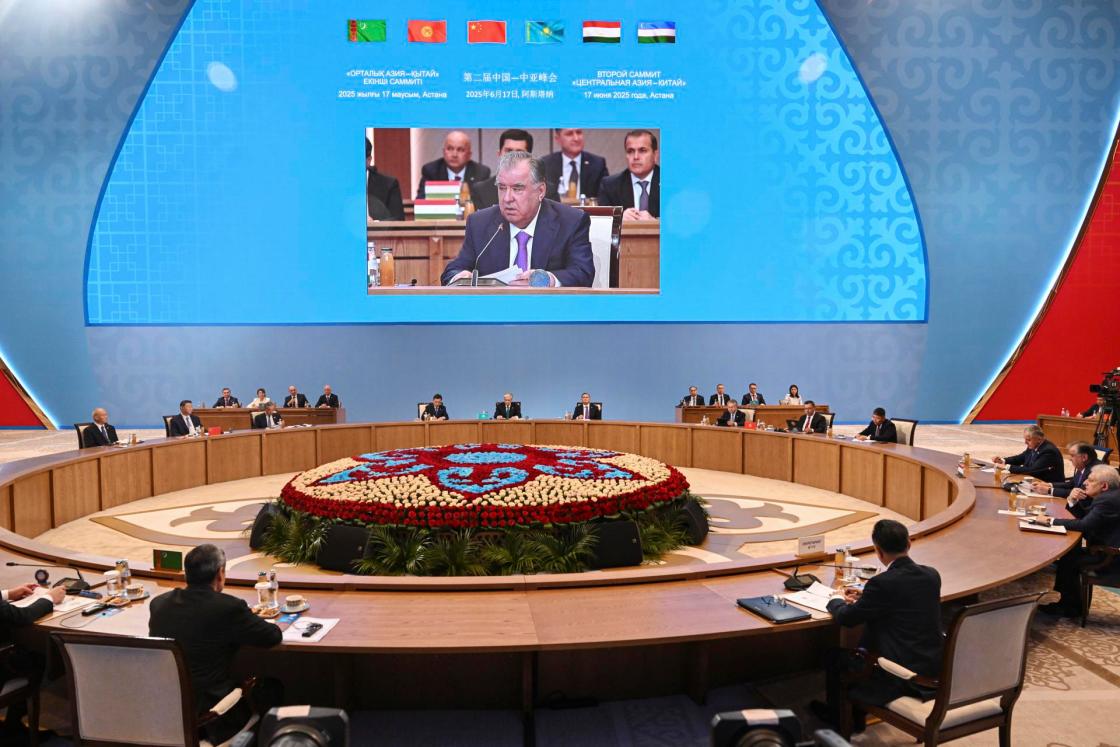
Astana, Jun 17 (EFE).- Chinese President Xi Jinping signed a historic Agreement on Good Neighborliness, Friendship, and Cooperation with Central Asia on Tuesday, where he defended free trade against US protectionism.
The agreement was signed in the Kazakh capital, Astana, at the end of the second China-Central Asia summit. The meeting was attended by the leaders of the five Central Asian republics.
The Asian leaders also signed an action plan for the ambitious Belt and Road Initiative—the new Silk Road. The route crosses the rugged terrain of Central Asia, which borders Russia, Iran, and Afghanistan.
In addition, Xi urged countries in the region to cooperate in the fight against extremism and terrorism and stressed that Beijing is interested in supporting the modernization of Central Asian armies and security forces, and in holding joint military exercises.
Along the same lines, the European Union also called for opening new trade routes along the ancient Silk Road during the summit it held in April in the historic Uzbek city of Samarkand, where it announced investments worth 12 billion euros.
A war without winners
“In a tariff and trade war, there are no winners. Unilateralism, protectionism, and hegemony will harm others and oneself,” Xi said during his speech at the summit plenary session.
He stressed that only “equal rights, justice, mutual benefit (…) will make it possible to maintain peace throughout the world and achieve common prosperity.”
Xi, whose country is the leading trading partner of the five Central Asian republics, lashed out at the “law of the jungle” in a constantly changing world. This was a clear reference to US President Donald Trump.
“China is willing to work with the countries of Central Asia to uphold international justice and counter the politics of hegemony and force,” he said.
He also announced a non-repayable loan of 1.5 billion rubles, more than $200 million, to support social projects. The aim is to improve living standards in the five countries of the region: Kazakhstan, Uzbekistan, Turkmenistan, Kyrgyzstan, and Tajikistan.


Peaceful nuclear cooperation
For his part, host and Kazakh President Kassym-Jomart Tokayev, with whom Xi signed more than 20 agreements on Monday, said that the relationship between Beijing and Central Asia has become “a strategic partnership.”
He noted that China accounts for 40% of the region’s foreign trade, which is now around $100 billion. In the case of Kazakhstan, trade amounts to 44 billion and investments to 26 billion dollars.
“Kazakhstan’s policy of attracting Chinese investment remains firm and consistent. This strategy is not a response to political circumstances,” he said.
He also advocated signing a nuclear cooperation agreement with China soon, given the Asian giant’s experience in the field of peaceful atomic energy.
Last week, Astana announced that Russia is to build the first nuclear power plant in the country’s history, while China has been chosen to develop the second plant.
Kazakhstan, like Ukraine, renounced its nuclear arsenal after the fall of the Soviet Union.
Tokayev also proposed to Xi a joint development project for a cargo terminal on the Caspian Sea, saying that 85% of Chinese goods destined for Europe travel through Kazakh territory.


Natural resources in exchange for technology
Xi and Uzbek President Shavkat Mirziyoyev agreed Tuesday to accelerate the construction of a railway line between the northwestern Chinese region of Xinjiang and the Central Asian republic via Kyrgyzstan.
A year ago, the three countries signed the corresponding intergovernmental agreement on the crucial project to reduce the time it takes to transport goods between China and the markets of the Middle East and Europe.
Known as CKU, the 523-kilometer railway is to cost 4.5 billion dollars and be able to transport around 15 million tons annually.
The project will link the towns of Kashgar (China), Jalal-Abad (Kyrgyzstan), and Andijan (Uzbekistan). As a result, it will bypass Russian territory, connecting China with Europe via Iran and Turkey, almost 1,000 kilometers and eight days shorter.
Meanwhile, Turkmenistan, a country bordering Iran, has said it is willing to increase gas and electricity exports to the Asian giant.
In return, all regional leaders are demanding technology transfers and cooperation from Beijing in areas such as space exploration and artificial intelligence.
Tokayev said that the region is home to 20% of the world’s uranium reserves, 17% of oil, and 7% of gas, in addition to large deposits of rare earth metals.
In addition to agreeing to work on a strategy for the China-Central Asia format for the next five years, it was decided that the next summit is to be held in a Chinese city in 2027.EFE
By Kulpash Konyrova