
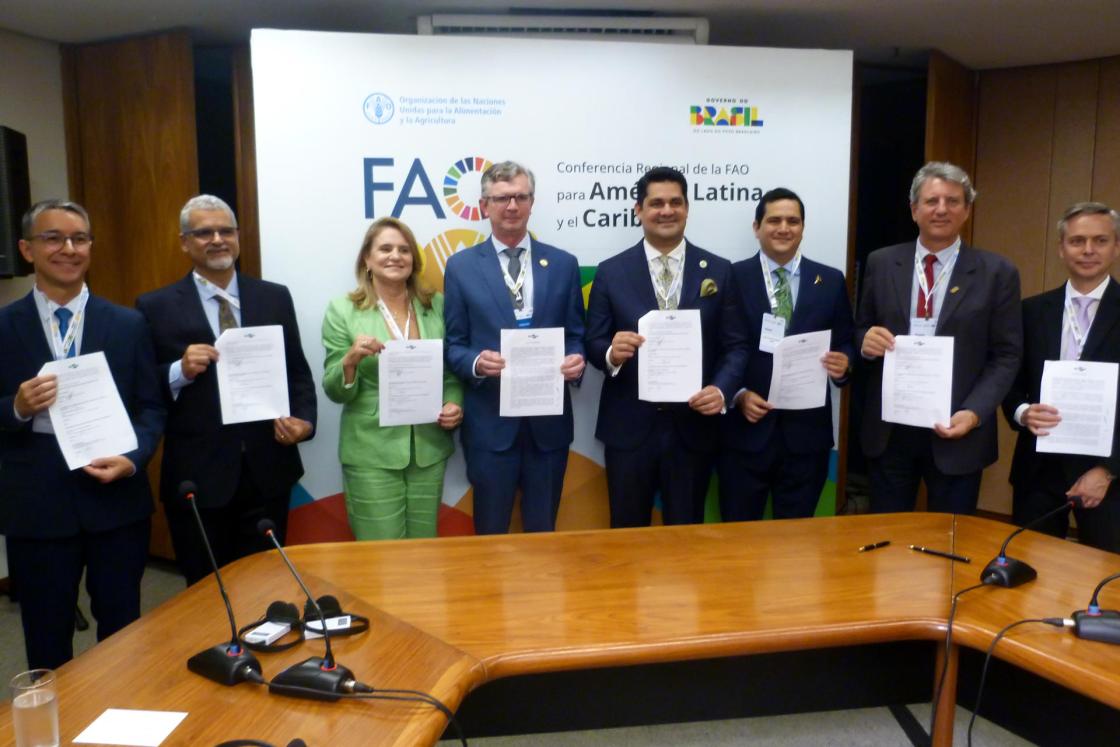
Brasilia, Mar 6 (EFE).- The Ecuadorian Banana Exporters Association (AEBE) and the Brazilian Agricultural Research Corporation (Embrapa) finalized a partnership on Thursday at the Itamaraty Palace in Brasilia to develop banana varieties resistant to the main diseases affecting plantations, such as Fusarium R4T and Moko.
The alliance began taking shape in January in Panama during the International Economic Forum of the CAF-Development Bank of Latin America and the Caribbean, when a letter of intent for financing was signed to join the program proposed by Embrapa for research, innovation, and genetic improvement of the Cavendish banana variety.
The project is expected to last five years and will focus on developing Cavendish cultivars resistant to Foc R4T and Moko.
The agreement was signed at Brazil’s Ministry of Foreign Affairs headquarters in the presence of Embrapa President Silvia Massruhá; Ecuador’s Minister of Agriculture, Juan Carlos Vega; AEBE Executive Director José Antonio Hidalgo; and the association’s president, Jorge Encalada.
Ecuador is the world’s largest exporter of bananas. Its leading industry association said the partnership represents a direct and urgent response to the phytosanitary threat posed by Fusarium. The fungus has been present in various Latin American countries for several years, but was first detected in Ecuador in December.
Strict biosecurity measures
The South American country managed to delay the fungus’s arrival since its first regional detections in 2019. It carried out strict biosecurity measures implemented by both the public and private sectors. These included initiatives such as SafeBanana, developed by AEBE and the Guayas and Los Ríos provincial governments, along with the efforts of agricultural and phytosanitary authorities. However, the current presence of the pathogen requires long-term solutions.
“For this reason, the development of new genetically resistant varieties is emerging as one of the only viable alternatives for the industry,” Encalada explained, highlighting the importance of the alliance with Embrapa.
Potential impact
AEBE warned that the potential impact of Fusarium on Ecuador’s economy would be devastating, as the banana industry supports around 250,000 direct jobs and is one of the main sources of non-oil exports.
Following the detection of Fusarium in Ecuador, the national strategy has focused on containing and isolating the outbreak through phytosanitary restrictions and specialized response teams.
“Currently, the strategy combines mandatory compliance with biosecurity measures on farms with a strong commitment to science and innovation,” Hidalgo added.
As part of the signing of this agreement, the AEBE delegation met with Embrapa’s Executive Director of Research and Development, Clenio Pillon, as well as researchers from Embrapa Cassava and Fruit Crops, who are responsible for the banana genetic improvement program.
The delegation also visited Brazil’s National Center for Genetic Resources and Biotechnology (Cenargen), where it learned about the center’s scientific capabilities in plant genetics and the conservation of plant genetic resources. EFE
EFE published this report with the support of AEBE.