
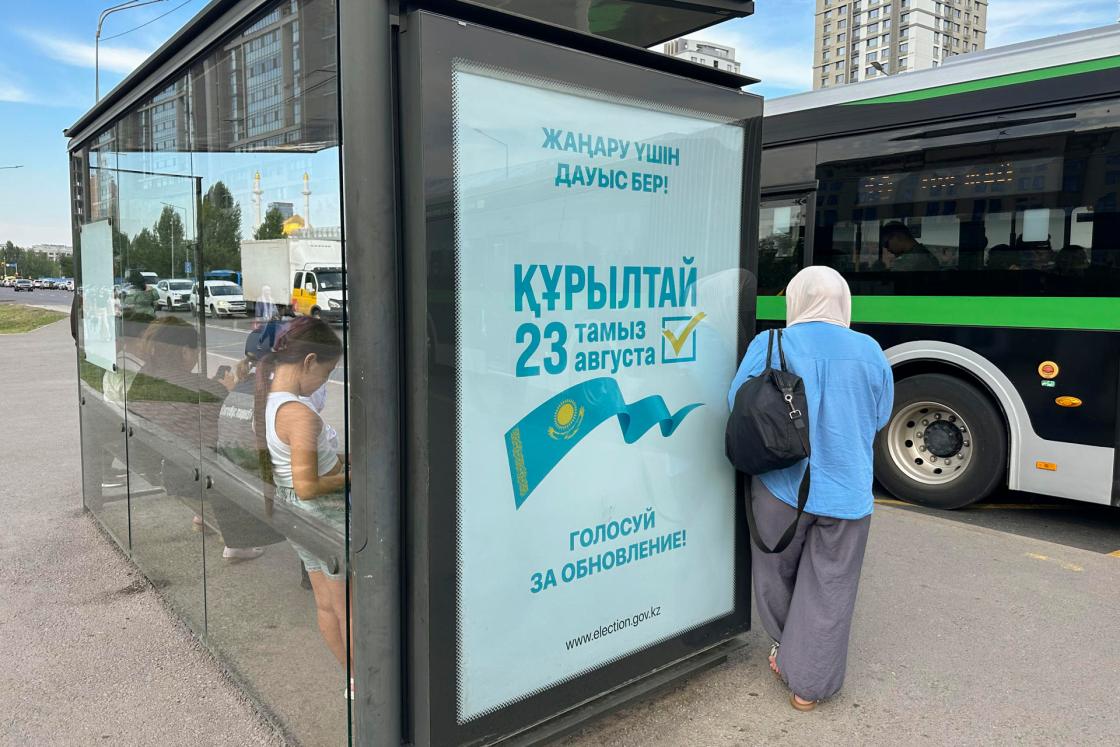
Kazakhs vote Sunday to elect the new unicameral parliament (Kurultai) of the largest Central Asian republic, on a historic day in which they will vote for programs and parties, rather than for candidates and names, as in the past.
“These elections will mark the starting point for new reforms that will benefit all citizens and open a new chapter in the history of modern Kazakhstan,” Kazakh President Kassym-Jomart Tokayev said Friday in a message to the nation.
Some 12.6 million Kazakhs are eligible to vote, of whom more than 70% have expressed their desire to exercise their right to vote.
Kurultai, a single parliamentary chamber
The new legislature, whose creation was approved in a constitutional referendum in March, will have 145 seats, to be elected proportionally by party lists.
The Kurultai can initiate a motion of censure against the government, and the president needs the chamber’s support to appoint the prime minister and the vice president, a figure included in the new constitution.
Tokayev explained that the Kurultai is one of the main manifestations of the perestroika (reform) he announced when taking office in 2019, and a new break with the leader of the nation, Nursultan Nazarbayev, whose image has severely deteriorated over time.
In his view, the chamber must simplify bureaucratic procedures and speed up the passage of laws. “In an era of total digitalization and artificial intelligence, the Kurultai must work quickly to adapt legislation to a rapidly changing reality,” he said.
However, its critics believe it will only strengthen presidential control over the legislature, since, among other things, it prevents independent candidates from standing for the chamber.
A renewed ruling party
The main difference for Sunday’s elections, in which seven parties will present 545 candidates, is that the ruling party has changed its name.
The Adilet (Justice) party, which was founded in May, merged a month later with Amanat, created in 1999 as a support platform for Nursultan Nazarbayev under the name Nur Otan.
According to experts, Adilet is the clear favorite, not only for victory but also to form a new constitutional majority with two-thirds of the votes, according to polls.
In second place, behind Adilet, will likely be the Auyl party, which represents the moderate opposition. Meanwhile, the other formations will focus their struggle on clearing the electoral threshold (5%).
Tokayev, for whom stability is more important than ever due to the impact of the war in Ukraine on the economy, said the elections must take place according to two principles: “Law and order.”
Among the remaining parties, Ak Zhol stands out, led by Daniya Yespayeva, a former presidential candidate who calls for closer ties with the European Union.
Nevertheless, independent political analysts told EFE that there is no real competition between parties in Kazakhstan, as all have been created “from above.” They add that “even though the parliament is unicameral, it will remain subject to the executive power.”
No changes or protests
For these reasons, no one expects the elections to bring about a sharp change either in the domestic landscape or in the foreign policy of the Central Asian country, which borders the Caspian Sea, China and Russia.
“The head of state defines foreign policy. Parliament, as was the case with its predecessor, will continue to play a secondary role,” explained political scientist Andrei Chebotarev at a press conference.
Tokayev made his stance clear in July when he urged Russian President Vladimir Putin to “freeze” the conflict with Ukraine, whose origins he said he did not understand, despite the Kremlin’s insistence on its historical roots.
Kazakh diplomacy will depend on how the events evolve in Ukraine, the Middle East, and the West, as well as the Central Asian region itself, which borders Iran and Afghanistan.
Indeed, Tokayev noted that amid “unprecedented geopolitical tensions and growing global challenges,” Kazakhstan must continue its strategy of transforming into a “truly developed nation.”
Analysts also rule out potential protests, as although social discontent exists, it is not widespread enough, nor does it have sufficient organizational resources for an anti-government mobilization.
They explain that post-election protests have never occurred in Kazakhstan, as residents of the Central Asian republic only take to the streets when a decision by those in power directly affects the interests of a large portion of the population.
With an average age of 31.5 years in Kazakhstan, Tokayev has persistently called on young people to vote. More critical Kazakhs, however, can choose the “Against All” option on the ballot. EFE