
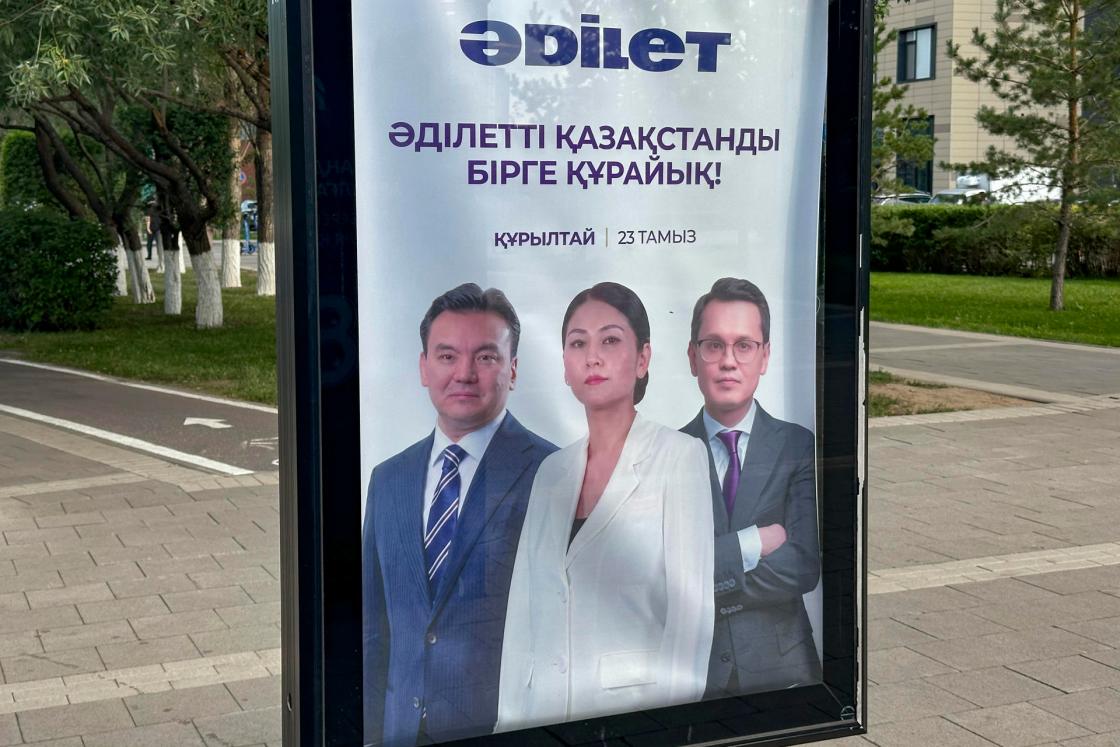
The ruling Adilet (Justice) party is the favorite heading into Sunday’s parliamentary elections in Kazakhstan, local experts agreed on Monday.
“Adilet undoubtedly dominates and will continue to do so ahead of the elections to the Kurultai (Kazakh parliament),” Kazakh political analyst Andrei Chebotaryov said at a news conference.
The expert explained that Adilet, founded in May of this year, consolidated its position after its merger with the Amanat party (formerly Nur Otan) two months ago.
The establishment enters the election with Adilet in a clear attempt to decisively sever ties with the era of Nursultan Nazarbayev, the former Kazakh president and leader of Nur Otan.
According to Chebotaryov, the Aul party is expected to place second behind Adilet. Meanwhile, the battle among the other parties will focus primarily on clearing the electoral threshold to gain entry to the Kurultai, the new unicameral parliament.
“Pollsters predict strong results for Aul, which will likely become the second-largest parliamentary force,” Chebotaryov said.
Political analysts agree that the main question mark surrounding the campaign is not so much who will win. They ask, rather, how much support the ruling party will secure and what role the remaining parties will play in the new parliament.
At the same time, they maintain that the new parliament will not lead to radical shifts in the country’s domestic or foreign policy. Analysts believe Adilet will maintain the government’s balanced approach, avoiding sharp pivots toward either Russia or the West.

Kazakhstan’s new unicameral parliament
Some 12.6 million residents of Central Asia’s largest republic are to vote Sunday to elect the country’s new unicameral parliament.
Following constitutional reforms proposed by President Kassym-Jomart Tokayev in March, the legislature will consist of a single 145-member chamber starting August 23, with members elected proportionally through party lists.
The campaign has proceeded without major incident amid widespread voter apathy and passivity, particularly among younger Kazakhs.
Experts attribute this to the lack of an electoral culture stemming from more than two decades of single-party dominance by Nur Otan. EFE